
This page compares international exam boards and tests in more detail. The subject structure is shown with examples, because each subject differs. Each example is taken from the official specification named in its table. Check the current specification for your subject before you choose.
Last checked: 14 November 2026.
Summary
| Route | Scale or grade | Assessment | Tiers | Sessions |
|---|---|---|---|---|
| Cambridge IGCSE | A* to G (or 9 to 1 in some syllabuses) | Written, practical and some coursework, at the end of the course | Core and Extended in many subjects (Core caps at grade C) | June and November |
| Pearson Edexcel International GCSE | 9 to 1 | Written exams, linear or modular in many subjects | Untiered in Biology | May–June and November |
| LRN International GCSE | Not published on LRN’s site (checked) | Not published on LRN’s site (checked) | Not checked | Not checked |
| OxfordAQA International GCSE Global Skills Projects (9697) | Scaled mark out of 200 | No exam. Individual project and group sustainability project | Not applicable | First assessment May/June 2026 |
| AP (College Board) | 1 to 5 | Exams per subject, with college credit set by each university | Not applicable | Set by College Board |
| SAT | 400 to 1600 total | Reading and Writing plus Math | Not applicable | Set by College Board |
| ACT | 1 to 36 composite | English, Math, Reading, optional Science and optional Writing | Not applicable | Set by ACT |
| OCR GCSE Biology A (J247) | 9 to 1 (Higher), 5 to 1 (Foundation) | Two written papers per tier, 90 marks each | Foundation and Higher | Set by OCR |
| AQA GCSE Biology (8461) | 9 to 1 | Two written exams, linear | Foundation and Higher | Set by AQA |
| WJEC GCSE Biology (3400) | A* to G (per the 2016 specification) | Two written exams plus scientific enquiry (10%) | Foundation and Higher for the exams | Set by WJEC |
Cambridge IGCSE
Cambridge IGCSE is assessed at the end of the course. It can include written, oral, coursework and practical assessment. Cambridge says this helps students whose first language is not English. Grades are A* to G. Some syllabuses also offer 9 to 1 grades. Sessions are in June and November. Results are issued in August and January.
Example: Cambridge IGCSE Biology (0610), 2026 to 2028 syllabus.
| Part | Core candidate | Extended candidate |
|---|---|---|
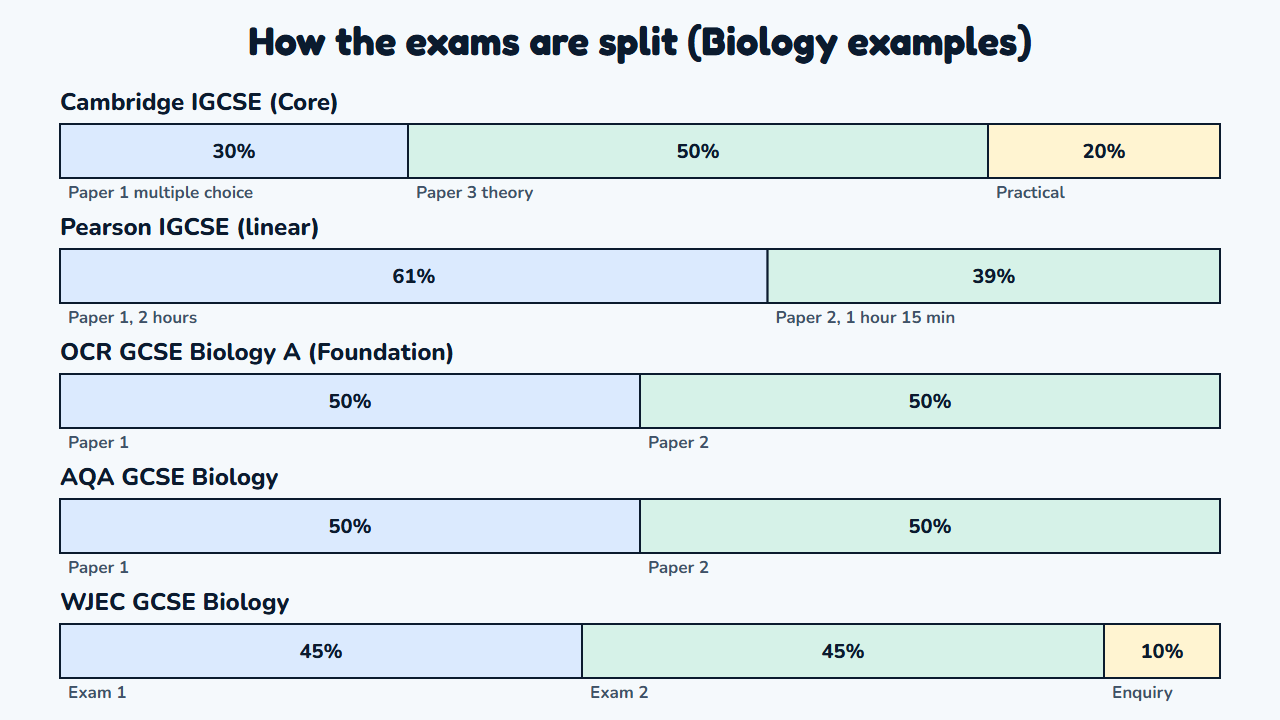
| Multiple choice | Paper 1, 40 marks, 30% | Paper 2, 40 marks, 30% |
| Theory | Paper 3, 80 marks, 50% | Paper 4, 80 marks, 50% |
| Practical | Paper 5 (practical test) or Paper 6 (alternative to practical), 40 marks, 20% | Paper 5 or Paper 6, 40 marks, 20% |
The syllabus says that candidates taught only the Core content can reach a maximum of grade C. Candidates aiming for A* to C should be taught the Extended content.
Read Cambridge’s qualification page and its grading choice page.
Pearson Edexcel International GCSE
Pearson’s International GCSEs use the 9 to 1 scale. Most subjects can be taken linear (all exams at the end) or modular (exams during the course). Check the subject, because some science options are available only linear.
Example: Edexcel International GCSE Biology (2017, linear). Biology is untiered, so every student can reach any grade.
| Paper | Time | Marks | Weighting |
|---|---|---|---|
| Paper 1B | 2 hours | 110 | 61.1% |
| Paper 2B | 1 hour 15 minutes | 70 | 38.9% |
Paper 1 uses multiple choice, short answer, calculations and extended response. Total mark is 180. Grades are 9 to 1.
Read Pearson’s International GCSE science guide for the linear and modular routes.
LRN International GCSE
LRN lists International GCSE subjects on its schools website. Examples include English Language, Mathematics, Biology, Chemistry, Physics, Sociology, Business, Accounting and Economics. International AS and A Level subjects are listed separately. The site does not publish a subject specification, paper structure or grading scale that we could check. Ask LRN for its subject specification before you choose. Start at the LRN International GCSE page.
OxfordAQA International GCSE Global Skills Projects (9697)
This is a full, standalone GCSE with no final exam. It is taught from September 2025, with first assessment in May/June 2026. The board recommends 120 to 140 guided learning hours.
| Component | Raw mark | Scaled mark | Share of GCSE |
|---|---|---|---|
| Individual project (product plus report, or artefact plus 500-word report) | 60 | 120 | 60% |
| Group sustainability action project (individual report of up to 2,000 words) | 48 | 80 | 40% |
| Total | — | 200 | 100% |
The group project is marked for each student’s own contribution only. The grade scale was not checked in this round. Read the official qualification page and the specification linked there.
AP (College Board)
AP exams are scored from 1 to 5. College Board describes 5 as extremely well qualified, 4 as very well qualified, 3 as qualified, 2 as possibly qualified and 1 as no recommendation. Credit and placement are set by each university. Many grant credit for a 3 or higher, but selective universities often require a 4 or 5. Each AP subject has its own exam format, which was not checked in this round. See AP Central.
SAT
| Score | Range |
|---|---|
| Total | 400 to 1600 |
| Reading and Writing section | 200 to 800 |
| Math section | 200 to 800 |
The score report shows eight content areas, four in Reading and Writing and four in Math. Read what the SAT scores mean.
ACT
The composite score runs from 1 to 36. It is the average of the English, Math and Reading scores, rounded to the nearest whole number. Science is an optional section. Writing is optional and reported separately. Read the ACT score guide.
UK domestic boards (AQA, OCR, WJEC, CCEA)
These boards write the qualifications used inside the UK. Students outside the UK usually sit them at an approved centre, so check the centre first.
AQA GCSE Biology (8461)
This qualification is linear. Students sit all exams at the end of the course. There are two written exams, each 1 hour 45 minutes and 100 marks, and each worth 50% of the GCSE. Foundation and Higher tiers are available. Read the AQA specification at a glance.
WJEC GCSE Biology (3400)
| Component | Format | Marks | Share of qualification |
|---|---|---|---|
| Written exam 1 | 1 hour 45 minutes, tiered (Foundation or Higher) | 80 | 45% |
| Written exam 2 | 1 hour 45 minutes, tiered (Foundation or Higher) | 80 | 45% |
| Scientific enquiry | Practical task (1 hour) and written task (1 hour), untiered | 28 | 10% |
Higher tier grades run from A* to D, and Foundation tier grades run from C to G. This comes from the WJEC specification PDF, the version published from 2016. Check that it is still the current version. Read the WJEC GCSE Biology specification.
OCR GCSE (9-1) Biology A, Gateway Science (J247)
This specification is Version 4.0, dated August 2026, from the OCR website. Learners take one tier. Foundation tier uses Paper 1 and Paper 2, and Higher tier uses Paper 3 and Paper 4. Each paper is a written exam of 1 hour 45 minutes, 90 marks and 50% of the GCSE. Foundation tier grades run from 5 to 1, and Higher tier grades run from 9 to 4. Papers 2 and 4 include synoptic assessment. Read the OCR Biology A specification.
CCEA
Not verified. The CCEA website blocks access from this location, so we could not check its Biology specification.
Frequently asked questions
Which route is easiest?
No route is easiest for every student. The best choice depends on whether the student does better with timed exams, project work, or a mix of both.
Can I compare subjects across boards?
Only after checking the current specification of each subject. Names and structures change, so use the official sites before you compare.
Check each official site before you pay or enrol. Last checked: 14 November 2026.