
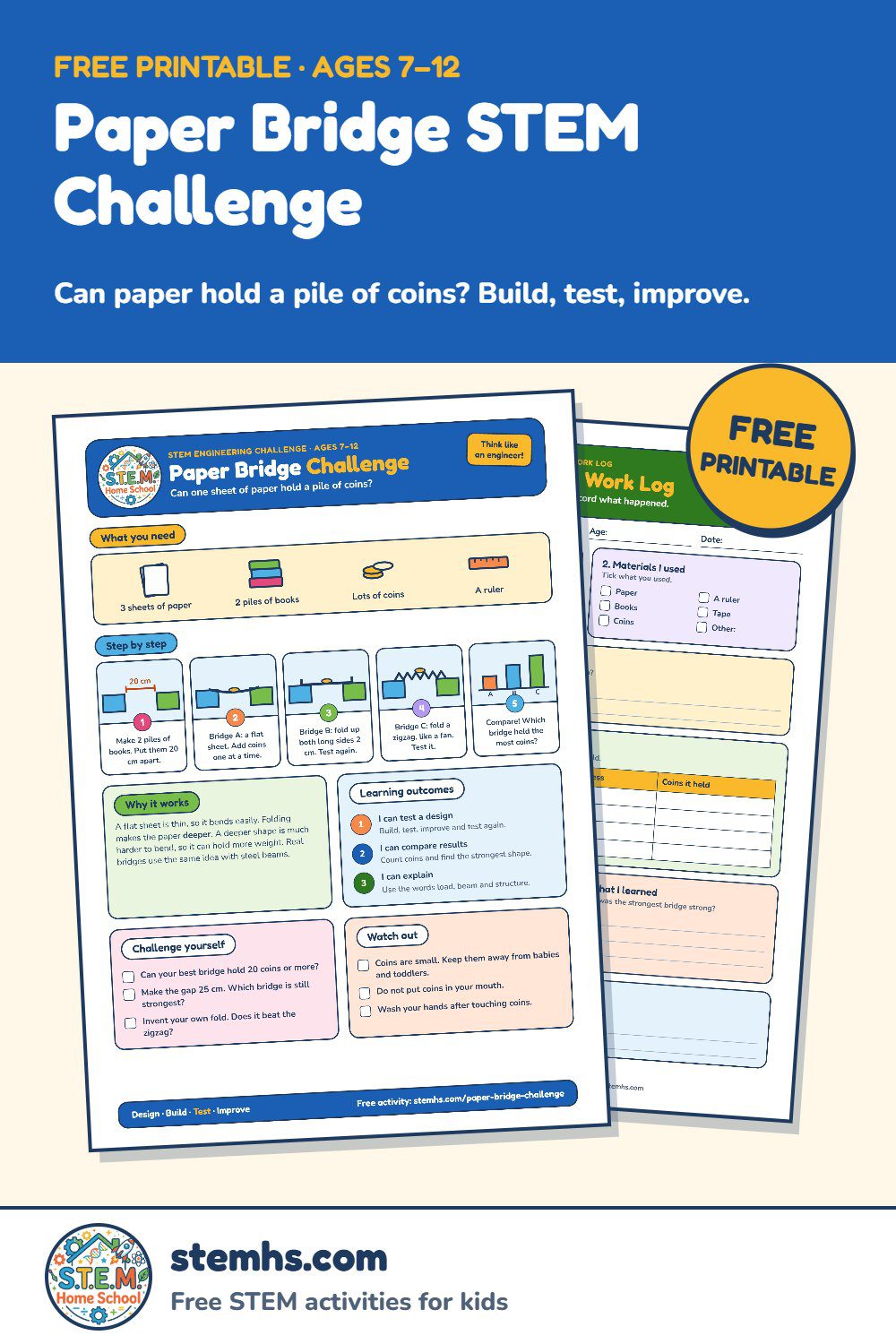
The Paper Bridge Challenge is a classic STEM activity where kids build a bridge from one sheet of paper and test how many coins it can hold. In this guide, you’ll test 3 designs, record results, and try the no-tape version.
The Paper Bridge Challenge is a classic STEM activity where kids build a bridge from a single sheet of paper and test how many coins it can hold. In this guide you will test 3 designs, record results in a worksheet, try the no-tape version, and learn how folding makes paper strong. Free 2-page printable included.
The Paper Bridge Challenge: build a bridge that holds the most coins
Free printable: instructions and work log
Two A4 pages: picture instructions for all 3 bridges, and a work log where your young engineer writes guesses, counts coins and draws the strongest design. No email needed.
Download the free PDF💡 Big Idea
The shape of a bridge can make it much stronger.
A flat sheet of paper bends easily. But fold the same paper, and it can hold much more. Engineers use shapes like this in real bridges!
🎯 What you will learn
- Test a design: I can build, test, improve and test again.
- Compare results: I can count coins and find the strongest shape.
- Explain: I can use the words load, beam and structure.
- Test fairly: I can keep the gap and the coins the same for every bridge.
📚 New Words
Tap each card to see what the word means.
🔬 Try It!
How to Do the Paper Bridge Challenge
- Make 2 piles of books. Put them exactly 20 cm apart. This gap is your span. 📏
- Bridge A: Lay a flat sheet of paper across the gap. Place coins in the middle, one at a time. Count until it falls. ✍️ Write the number.
- Bridge B: Fold up each long side of a new sheet by exactly 2 cm. Crease sharply with a ruler. Test the same way. Write the number.
- Bridge C: Fold a new sheet into a zigzag, pleating at 2 cm intervals (forward, back, forward, back). Lay across the gap. Test. Write the number.
- Which bridge held the most coins? Can you make it even stronger? Try again! 🔁
🤔 Guess first!
Before you test, guess: which bridge will hold the most coins? A, B or C?
📊 Our test results
Here is what happened when we built all three bridges.
| Bridge | Test 1 | Test 2 | Test 3 | Middle number |
|---|---|---|---|---|
| A: Flat | 3 | 4 | 4 | 4 |
| B: Sides up (2 cm) | 28 | 31 | 34 | 31 |
| C: Zigzag (2 cm pleats) 🏆 | 85 | 89 | 93 | 89 |
Our test used A4 copy paper (80 gsm) and UK 1p coins across a 20 cm span. Your numbers will differ — that is the point. Test fairly and record honestly.
🗝️ How to Make a Paper Bridge Strong
In the Paper Bridge Challenge, a flat sheet is very thin, so it bends easily. 📄
When you fold the paper, you make it deeper. A deeper shape is much harder to bend. The zigzag has many folds, so it is usually the strongest!
Same paper + better shape = stronger bridge!
This is the same idea engineers use to meet NGSS engineering standards in real bridge design.
⚠️ Paper Bridge Challenge Troubleshooting
When a bridge fails, ask what went wrong. That is exactly what real engineers do.
🏆 Paper Bridge Challenge Solutions
Four winning designs to try. Each one adds depth in a different way. Exact measurements included.
Zigzag / Accordion
Held 89 coins in our testHow: Pleat at 2 cm intervals, forward-back-forward, across the whole sheet.
Best for: Maximum strength. Hardest to fold neatly.
U-Channel
Held 31 coinsHow: Fold both long edges up by exactly 2 cm. Crease sharply with a ruler.
Best for: Quick builds. Can twist under off-centre loads.
Triangle Beam
Held 41 coinsHow: Fold lengthwise into thirds (~7 cm each). Stand on edge like a long tent.
Best for: Compression strength. Narrow top makes coin stacking tricky.
Double-Layer Zigzag
Held 103 coinsHow: Fold the sheet in half first, then pleat the doubled sheet at 2 cm intervals.
Best for: Record-breaking weight. Uses more paper.
✂️ One Piece of Paper, No Tape
This is the classic Paper Bridge Challenge version many schools use. You get one sheet of paper and nothing else. No tape, no glue, no scissors. You may only fold.
📋 The rules
- One A4 or Letter sheet.
- Fold it any way you like. No tape.
- Bridge must cross a 20 cm gap between two piles of books.
- Put coins on the middle, one at a time, until it falls.
💡 Exact folds to try
- Zigzag: pleat at 2 cm intervals, forward-back-forward.
- U shape: fold up both long sides by exactly 2 cm.
- Triangle beam: fold lengthwise into thirds (~7 cm each), stand on edge.
- Double layer: fold in half first, then zigzag the doubled sheet.
🤔 Guess first: Which shape will hold the most coins without any tape?
👥 Team Building Version
Great for classrooms, scout groups and birthday parties. Teams of 3–4, one sheet per team, 20 minutes total.
- Plan (5 min): Each team sketches their design on paper before touching the sheet.
- Build (10 min): One sheet, no tape, no glue. Every team member must make at least one fold.
- Test (5 min): Test one team at a time. Write each team’s coin count on the board.
- Explain: Winning team explains their design to the class. Every team names one thing they would change.
✍️ Paper Bridge Challenge Worksheet
After the Paper Bridge Challenge, your teacher may ask for a write-up. Use these five parts. Keep each part short.
- Question: Which paper shape holds the most coins?
- Prediction: The zigzag bridge will hold the most coins, because it is deeper.
- Method: The gap was 20 cm. Coins went on the middle, one at a time. Each bridge was tested 3 times.
- Results: Put the numbers in a table, like the one below.
- Conclusion: Say what happened, then say why. Use the numbers.
| Bridge | Test 1 | Test 2 | Test 3 | Middle number |
|---|---|---|---|---|
| A: flat | ||||
| B: folded sides | ||||
| C: zigzag |
✅ Sounds like a scientist
“The zigzag bridge held the most coins: ___ coins. Folding made the paper deeper, so it bent less.”
✏️ Make it sound formal
Leave out “I think” and “my”. Write what the results show. Say “The results show that folding made the bridge stronger.”
🧠 Quick Quiz
Say your answer out loud. Then tap the card to check!
Great job, engineer!
You built, tested and improved a bridge. That is real engineering!
👪 For Grown-ups
During the Paper Bridge Challenge, let your child guess before each test and write down every result. Results change with the paper and coins you use, so the goal is fair testing, not one right answer. Ask “What could make it stronger?” and let them try their own ideas. For more open-ended science, browse the Exploratorium’s hands-on resources.
Why does folded paper hold more coins than flat paper?
Folding makes the paper deeper. A deeper shape is much harder to bend, so the bridge sags less and holds more weight. Engineers use the same idea in corrugated cardboard and steel beams.
How far apart should the books be?
Start with a 20 cm gap. A wider gap makes every bridge bend more, so it is a good next challenge once your child has tested all three designs.
What age is the paper bridge challenge for?
It suits ages 7 to 12. Younger children can join in if a grown-up helps with folding. Older children can record each result in a table and test their own designs.
Can you do the paper bridge challenge with one piece of paper and no tape?
Yes. That is the classic version. Use one sheet, fold it into a zigzag, a U shape or a triangle beam, and lay it across a 20 cm gap. Folding alone can make the paper strong enough to hold many coins.
How do I write up the paper bridge experiment?
Use five short parts: the question, your prediction, the method, a results table and a conclusion. In the conclusion, say which bridge held the most coins and why, using your numbers. Leave out “I think” for a more formal tone.
What is the strongest paper bridge design?
The zigzag (accordion) fold is usually strongest because the pleats add depth and resist bending. In our test, a zigzag bridge held 89 coins across a 20 cm span.
How much weight can a paper bridge hold?
It depends on the paper, the fold and the span. A flat sheet may hold only a few coins, while a zigzag fold can hold dozens. Record your own results, that is the real engineering data.
What paper is best for a paper bridge?
Standard copy paper (A4 or Letter) works well. Thicker paper adds stiffness but is harder to fold precisely. Crease every fold sharply with a ruler for the best result.
Did you finish?
Press the button to collect your Junior Engineer badge.