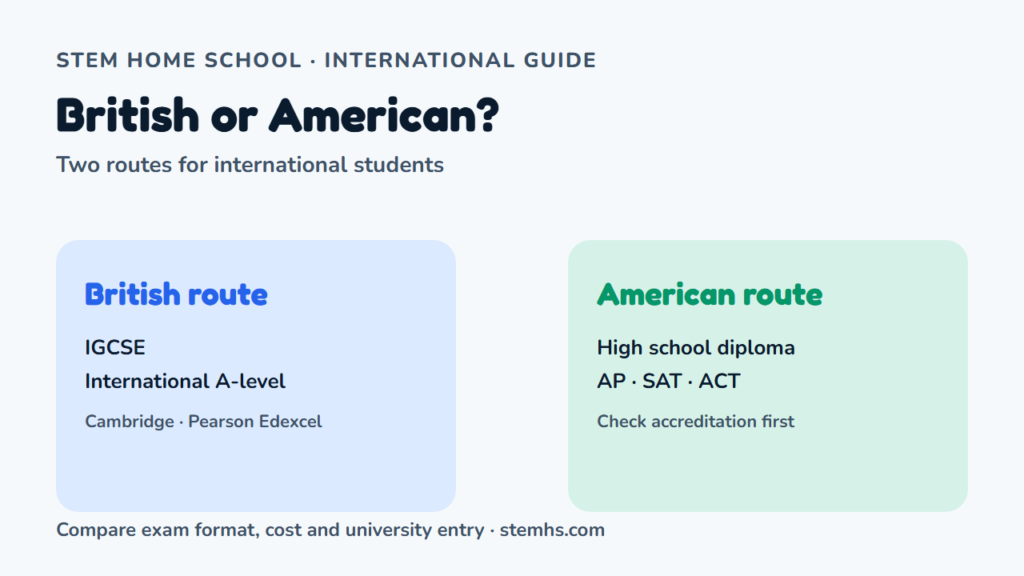
The British route uses subject exams such as IGCSE and A-level, usually from Cambridge International or Pearson Edexcel. The American route uses a high school diploma, with AP courses and SAT or ACT tests. Both routes lead to good universities. The better choice depends on where your child wants to study next, and on what each school or provider offers.
Start with the basics
Choosing a British or American curriculum for international students is a big decision. Many families who live outside the UK and US still need an exam route that other countries recognise. This guide compares the main options. It explains each route in plain English and gives you a short checklist before you choose.
We do not sell courses or exams. We want you to ask the right questions and check the official sources.
What is the difference between British and American curricula?
A British curriculum is built around subject exams. A student takes several subjects, each with its own exam, usually at age 16 (IGCSE) and age 18 (A-level or International A-level).
An American curriculum is built around a high school diploma. A student earns credits over four years, usually from grade 9 to grade 12. Some students also take AP courses, which are college-level classes with their own exams.
Neither route is better in every case. They are built differently, so they suit different goals.
The British exam boards for international students
Several boards offer British-style qualifications to students outside the UK. Three are most common.
Cambridge International
Cambridge International offers Cambridge IGCSE and Cambridge International A Level. It has a wide list of subjects and runs exams in many countries. Read the official Cambridge International programmes page for the current list.
Pearson Edexcel International
Pearson Edexcel offers International GCSEs and International A Levels. They are part of the iProgress family of qualifications for students aged 5 to 19, written for international schools. Most International GCSEs can be taken as linear (exams at the end of the course) or modular (exams during the course), so ask which option your school uses. International GCSEs run in May–June and November sessions. Check the official Pearson International GCSE page for subjects and exam details.
UK domestic boards
AQA, OCR, WJEC and CCEA write the GCSE and A-level qualifications used inside the UK. Students outside the UK usually need an approved exam centre to sit them. Check with the centre before you enrol. You can read the AQA website for its current entry rules.
GCSE, IGCSE and International A-level: what changes?
The names are similar, but the details differ. The table below shows the main points for the two IGCSE boards. Always check the official subject specification before you choose.
| Point to check | Cambridge IGCSE | Pearson Edexcel International GCSE |
|---|---|---|
| Tiers in science | The Core tier can reach a top grade of C only | Some subjects are untiered, so any student can reach any grade |
| Subject range | A very wide list of subjects | A wide list, but check the subject you need |
| Usual next step | Cambridge International A Level | Edexcel International A Level or UK A-levels |
| Exam sessions | Check the current session dates for your subject | Sessions in May–June and November |
| Changes in 2026 | Check the board for 2026 changes | Check the board for 2026 changes |
UK universities generally treat IGCSE as equal to GCSE. Each university sets its own entry requirements, so check the course page you want.
The American route: diploma, AP, SAT and ACT
The high school diploma
An American high school diploma needs a set number of credits. Each school sets its own rules, so ask for the graduation requirements in writing. Credit numbers vary by state and by school.
AP courses and exams
AP courses are college-level classes. At the end of the course, students sit an AP exam. The exam is scored from 1 to 5. Many US universities give credit or placement for good AP scores. Policies differ, so read the admissions page of each university. You can read more on the AP Central website.
SAT and ACT
The SAT and the ACT are standard admissions tests. Many US universities are test-optional, which means scores are not always required. International applicants often still send scores because they help the university compare results. Check the official SAT site and the official ACT site for test dates and fees.
Why accreditation matters
Accreditation means an official body has checked that a school meets set standards. A diploma from an accredited school is much easier to use for university entry. Some schools offer diplomas without any accreditation. Ask which body accredits the school, then check that body’s public list. One example is the WASC accreditation site.
Newer boards and project-based options
Some boards are newer to the international market. Others offer project work instead of a final exam. This table shows what the official sites say today. Check each board’s current specification before you enrol.
| Board | What it offers | How it is assessed | Official site |
|---|---|---|---|
| LRN (Learning Resource Network) | International GCSE and International A Level, plus other qualifications for schools | Written exams for subjects such as English Language. Check the subject list on the site. | lrnglobal.org |
| OxfordAQA International GCSE Global Skills Projects (9697) | A full, standalone GCSE built around project work, planning, research and report writing | No final exam. An individual project and a group sustainability project. The board recommends 120–140 guided learning hours. | OxfordAQA qualification page |
LRN describes itself as an Ofqual-regulated awarding organisation. Confirm its current status on the Ofqual register before you rely on it.
A project-based GCSE suits students who learn well by doing. It also needs strong self-management, because there is no final exam to set deadlines. Ask the school how it supports the project work. Ask how it marks each student’s own contribution in group projects.
For subject-by-subject structure, grading and paper weightings, read our detailed comparison of international boards and tests.
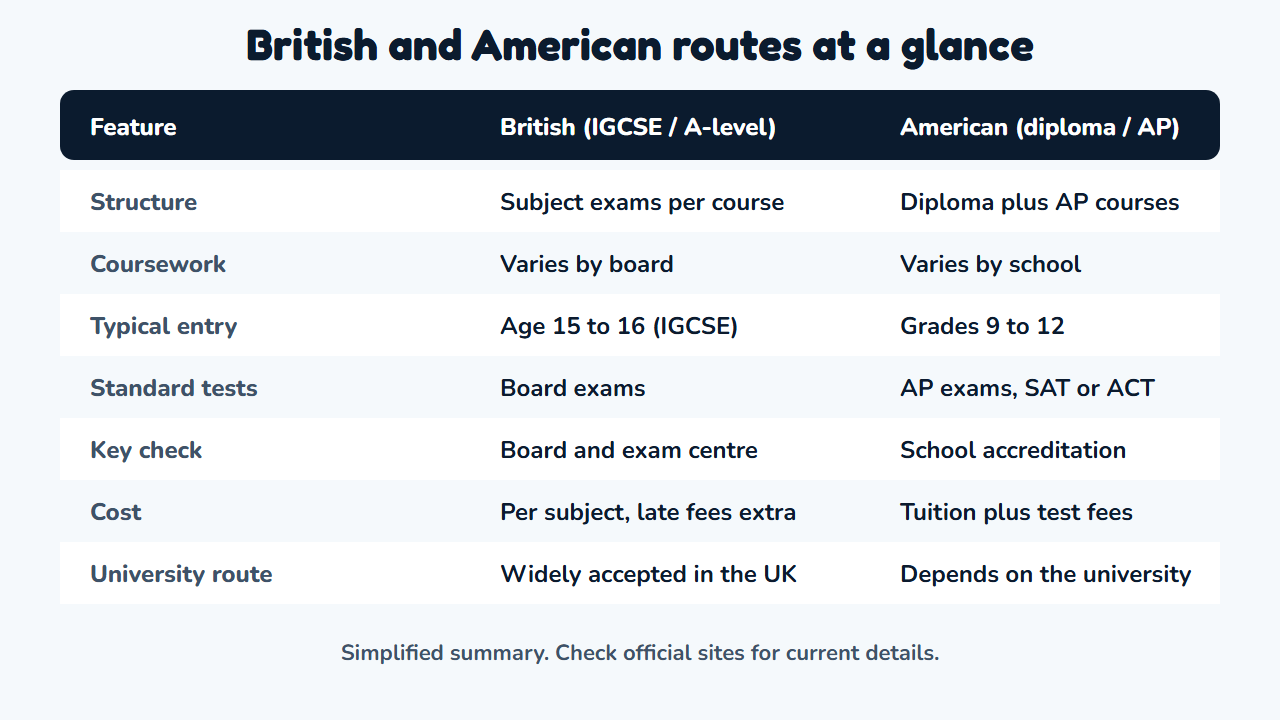
Comparison: British and American routes side by side
This table gives a simple view. Use it to start your research, then check the details with each school and board.
| Feature | British route (IGCSE and A-level) | American route (diploma and AP) |
|---|---|---|
| Basic structure | Separate exams in each subject | Credits over grades 9 to 12, plus optional AP courses |
| Coursework | Varies by board and subject | Varies by school |
| Standard tests | Board exams | AP exams, SAT or ACT |
| Main check before you enrol | Board and exam centre | School accreditation |
| University acceptance | Widely accepted in the UK | Depends on the university and the country |
| Cost | Per subject, with late entry fees on top | Tuition, plus test and exam fees |
Which pathway should you choose?
Start with your goal. Then use the chart below to narrow your options.
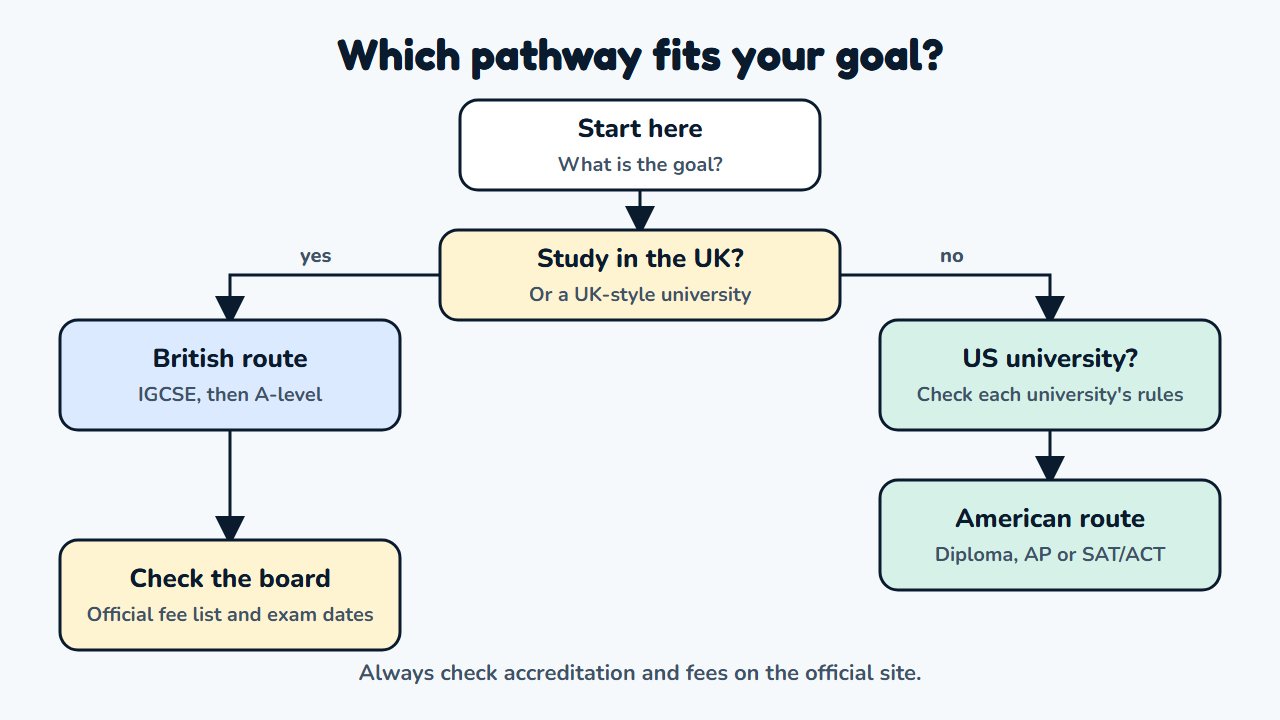
- You plan to study in the UK: IGCSE and A-level or International A-level are a common route. Check the entry requirements of your target universities.
- You plan to study in the US: A diploma from an accredited school, with AP courses or SAT or ACT scores, is a common route. Check what each university asks for.
- You plan to study in another country: Check the national rules first. Some countries accept British qualifications, others prefer American ones, and some want both.
- You want to stay in a local school system: Ask your local school how it treats international qualifications before you start.
How much does it cost?
Fees change every year, and they often differ by country and by centre. Do not rely on a figure from a blog, including this one. Check the official fee list instead.
| Where to check | What to look for |
|---|---|
| Cambridge International | Current exam fees and any late entry charges |
| Pearson Edexcel International | The current fee list for International GCSE and A Level |
| British Council private candidate registration | Whether you can enter exams without joining a school, and the rules for ID |
| UCAS entry requirements | General guidance on UK university entry |
Late entry fees can be much higher than the standard fee. Enter exams on time where you can.
Questions to ask a school or provider
Ask these questions before you pay any deposit:
- Which body accredits the school, and can I check that on their public list?
- Which exam board do you use, and where are the exams taken?
- What are the total costs, including exam, late entry, test and materials fees?
- Who is my contact if a student misses an exam or needs a remark?
- What support is there for a student who is learning in English?
Our international pathways section on the curriculum page lists the other guides we are preparing. Our parent guide explains how we plan lessons for children learning at home.
Related pages on stemhs
- International exam boards hub
- Detailed comparison of subject structures and tests
- Curriculum hub: international pathways
- STEM lessons for ESL learners
- Lessons on stemhs
- Printable worksheets
Frequently asked questions
Is IGCSE the same as GCSE?
They are very close. Both are taken at around age 16 and are widely accepted in the UK. Cambridge IGCSE and Edexcel International GCSE are both IGCSE routes. Their exam structure can differ, so check the subject details on each board’s website.
Do UK and US universities accept AP?
Many US universities give credit or placement for good AP scores. Policies differ by university, and UK universities set their own rules. Check the admissions page of each university you want.
Can my child take international exams without joining a school?
In some cases, yes. The British Council offers private candidate registration for some International GCSE and A Level exams. You will need a valid passport or national ID. Check the current rules and fees before you apply.
Do I need an accredited school for a US diploma?
For most universities, yes. Accreditation shows that the school meets official standards. Ask the school which body accredits it, then check that body’s public list.
Last checked: 14 November 2026. Fees and exam dates change each year. Check the official site before you pay or enrol.