Make a fizzing volcano and find out what makes the bubbles
Free printable: activity sheet and record sheet
Two A4 pages: picture steps, learning outcomes, a fair test table, a “use your senses” box and a bonus balloon test. No email needed.
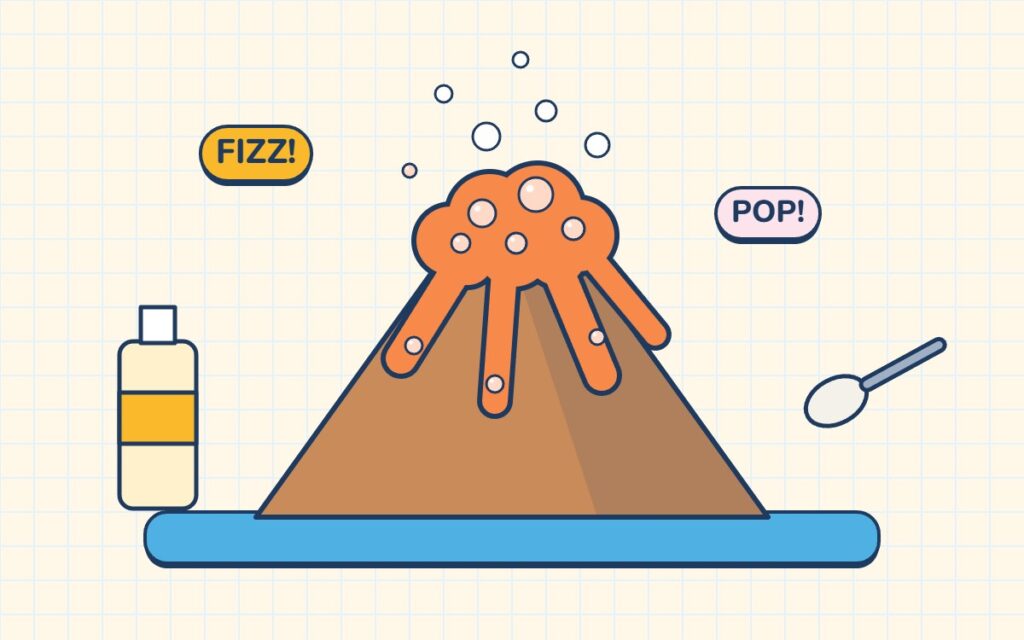
Download the free PDFWhen baking soda and vinegar mix, they make something new: a gas called carbon dioxide. The gas makes bubbles, and the bubbles push the foam up and out.
This is called a chemical reaction. A real volcano works in a different way, but the foam looks a lot like lava. Let’s make one!
- Observe: I can say what I see, hear and smell.
- Explain: I can say that a chemical reaction makes something new, a gas called carbon dioxide.
- Test fairly: I can change one thing and keep everything else the same.
- Measure and compare: I can count how long it fizzes and compare my results.
Tap each card to see what the word means.
- Do this with a grown-up. 👪
- Keep your face back from the cup. Vinegar stings if it gets in your eyes. 👀
- Never put a lid on the cup or bottle. The gas needs space to get out. 🚫
- Do not drink the mix. Wash your hands when you finish. 🧼
- Put a small cup on a tray. The tray catches the foam.
- Add 1 tablespoon of baking soda to the cup.
- Pour in 2 tablespoons of vinegar. Step back and watch.
- Observe the bubbling. Then try again with more vinegar and compare.
👀 What to observe
🌋 Make it look like a volcano
Build a cone of play dough or paper around the cup. Add a drop of washing-up liquid for more foam and a drop of red or orange food colouring for lava.
🤔 Guess first: Will more vinegar make a bigger fizz or the same fizz?
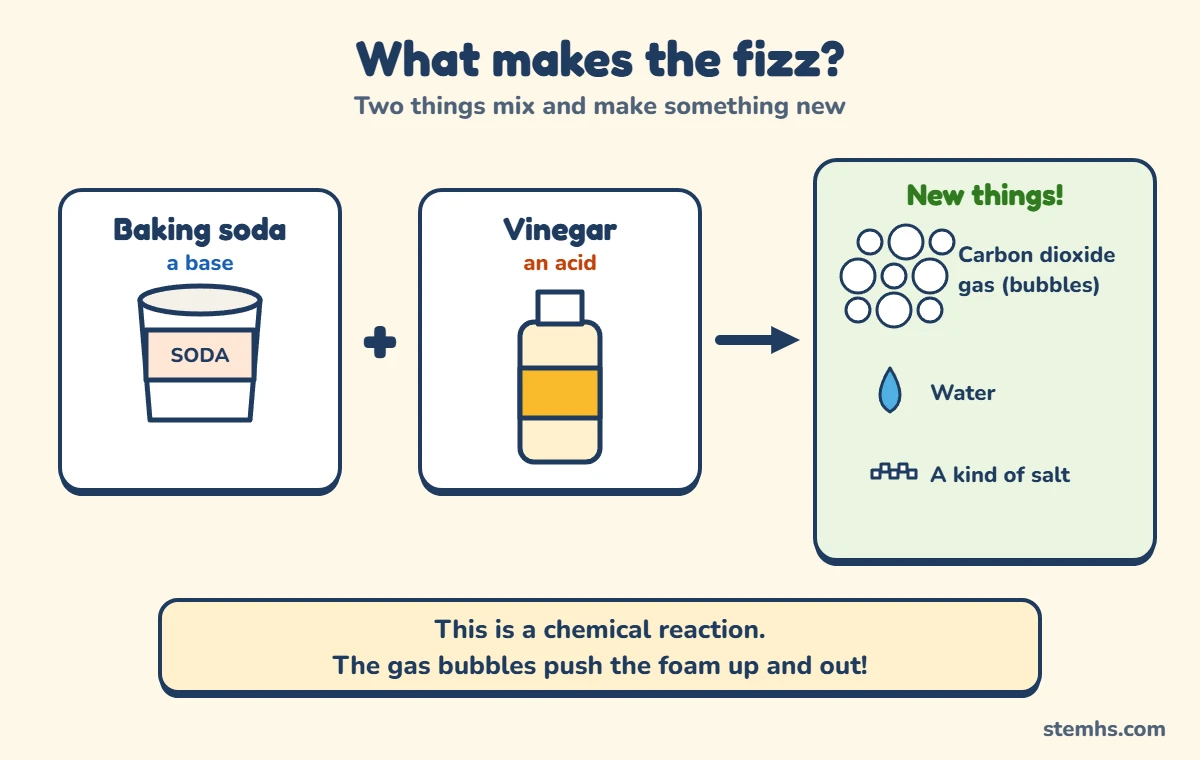
Vinegar is an acid. Baking soda is a base. When they touch, they react and make three new things: water, a kind of salt and a gas called carbon dioxide. The gas makes lots of bubbles very fast. There is not enough room in the cup, so the foam pours over the top.
You cannot turn the foam back into baking soda and vinegar. That is how you know it was a chemical reaction, not just mixing.
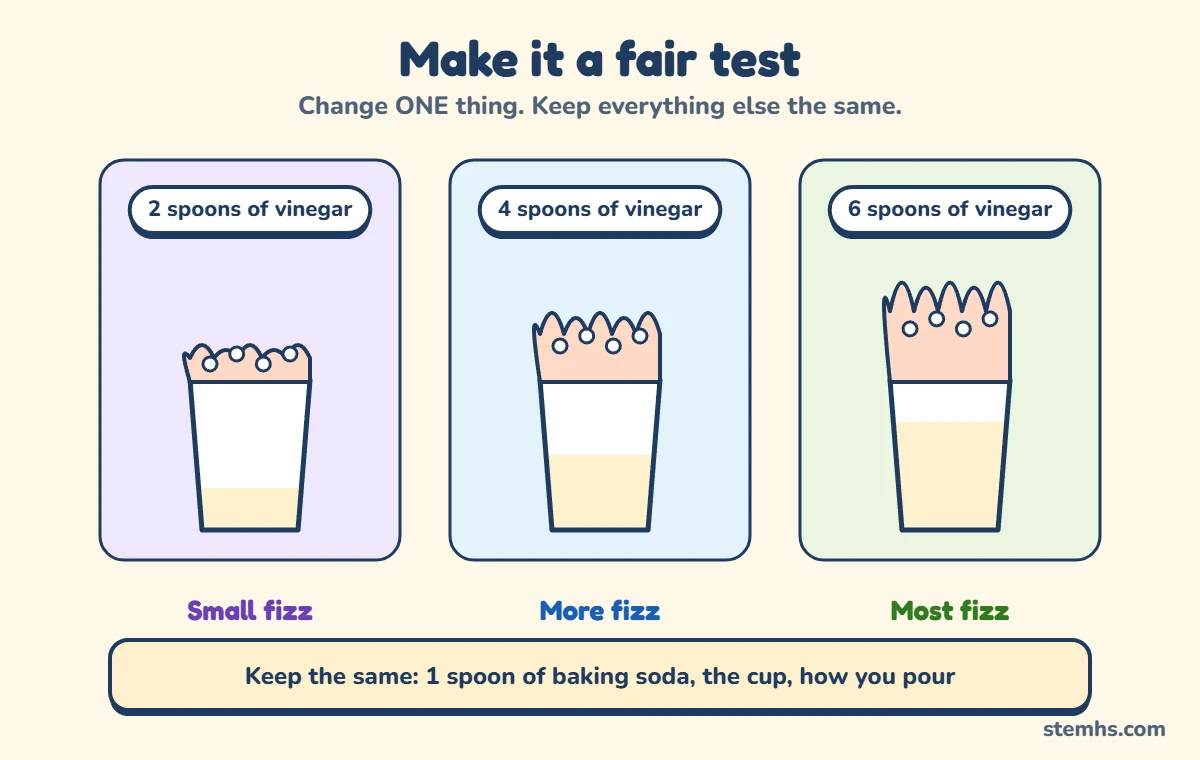
Scientists change only one thing at a time. Then they know what made the difference. In this test you change the vinegar. You keep the baking soda the same.
🔁 Change
The vinegar: test 2, then 4, then 6 tablespoons.
🔒 Keep the same
1 tablespoon of baking soda, the same size cup (clean and dry each time) and the same way of pouring.
📏 Measure
Count the seconds until the fizz stops. Is the foam small, medium or big?
How much baking soda and vinegar?
Start small. Use a tablespoon for measuring.
| Volcano | Baking soda | Vinegar | What you get |
|---|---|---|---|
| Small cup | 1 tablespoon | 2 tablespoons | A quick fizz |
| Bigger fizz | 1 tablespoon | 4 tablespoons | Taller foam that lasts longer |
| Bottle volcano | 2 tablespoons | 120 ml (half a cup) | A big, foamy eruption |
Is a bigger mix stronger?
Not always. Look at two mixes:
Mix A
6 spoons of baking soda with 10 scoops of vinegar.
6 ÷ 10 = 0.6
Mix B
9 spoons of baking soda with 15 scoops of vinegar.
9 ÷ 15 = 0.6
Both give the same number, so both mixes have the same concentration of baking soda. Mix B is bigger, so it makes more foam. But it is not stronger. To compare two mixes, divide the baking soda by the vinegar.
Predict, observe, explain
Scientists do these three things in order. Say them out loud, or write them on the record sheet.
1. Predict
“I think more vinegar will make the fizz last longer, because there is more to react.”
2. Observe
Count the seconds of fizz. Is the foam small, medium or big? What do you hear and smell?
3. Explain
“More vinegar reacted with the baking soda, so more carbon dioxide gas was made. The fizz stopped when the baking soda was used up.”
Turn it into a science fair project
A science fair project needs one question you can test. Here is one that works well:
Does the amount of vinegar change how long the volcano fizzes?
🔁 Change
The vinegar: 2, 4 and 6 tablespoons.
🔒 Keep the same
1 tablespoon of baking soda, the same cup and the same way of pouring.
📏 Measure
Seconds of fizz. Test each amount 3 times and use the middle number.
Hypothesis: “If I add more vinegar, then the volcano will fizz for longer, because more gas is made.”
Your display board
- Left panel: your question and hypothesis.
- Middle panel: what you used, your steps and photos.
- Right panel: your results table, a bar chart and your conclusion.
Plan it with our free Fair Test Planner, and record your results on the Volcano Record Sheet.
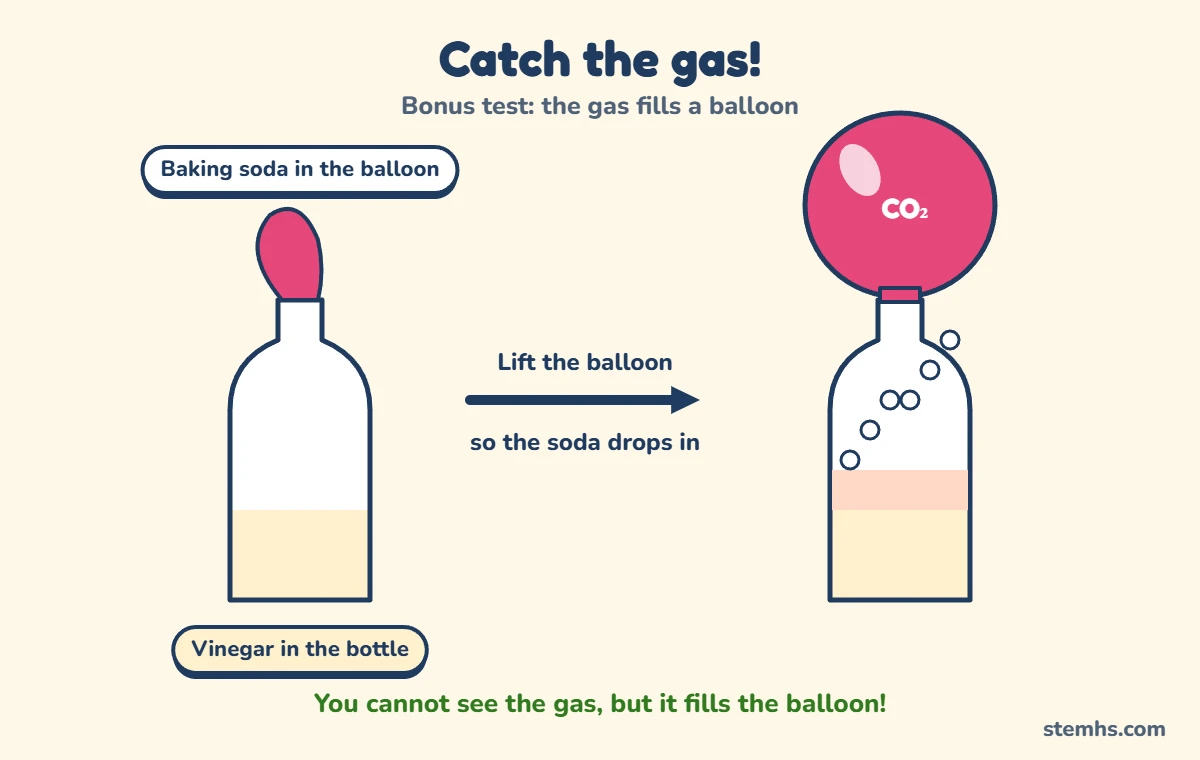
Put 4 tablespoons of vinegar in an empty plastic bottle. Use a funnel to put 1 tablespoon of baking soda inside a balloon. Stretch the balloon over the bottle top, then lift it so the soda drops in. The gas has nowhere to go except into the balloon, so the balloon gets bigger. Now you can see that the gas is real!
Great job, scientist!
You made a chemical reaction, saw a gas at work and ran a fair test!
Younger children (5 to 7) will enjoy pouring and describing what they see, hear and smell. Older children (8 to 10) can run the fair test, time the fizz and explain why the fizz stops. Ask “What changed? What stayed the same?” after each test. That question is the heart of a fair test.
Curriculum links: England Key Stage 1 Working Scientifically (observe closely, perform simple tests) and Year 5 Properties and changes of materials (new materials made by the action of acid on bicarbonate of soda; changes that cannot be reversed). US NGSS 5-PS1-4 (investigate whether mixing two substances makes a new substance).
More help: STEM in Simple English for children learning English, and our free parent guide. Try next: Sink or Float? for more predicting and sorting, or 5 Kitchen Science Experiments.
What is a chemical reaction?
A chemical reaction is when two or more things mix and change into something new, and you cannot easily turn them back. When baking soda meets vinegar, they make a new gas called carbon dioxide. The fizzing bubbles you see are that gas escaping.
❓ Questions parents ask
Why do baking soda and vinegar fizz?
Vinegar is an acid and baking soda is a base. When they mix, they react and make carbon dioxide gas, water and a kind of salt. The gas forms lots of bubbles at once, and that is the fizz you see and hear.
Is the baking soda volcano a chemical reaction?
Yes. New substances are made, a gas is given off and you cannot change the mix back into baking soda and vinegar. These are all signs of a chemical reaction.
Is the baking soda and vinegar volcano safe for kids?
Yes, with a grown-up nearby. Vinegar stings if it gets in the eyes, so keep faces back from the cup. Never seal the mix in a closed container with a lid, because the gas needs space to escape.
How do you make the volcano foam more?
Add a drop of washing-up liquid (dish soap) before the vinegar. The soap traps the gas in bubbles, so the foam is thicker and lasts longer. More vinegar also makes more gas, up to the point where the baking soda runs out.
How much baking soda and vinegar do I need?
Start with 1 tablespoon of baking soda and 2 tablespoons of vinegar in a small cup. For the fair test, keep the baking soda at 1 tablespoon and try 2, 4 and 6 tablespoons of vinegar.
What age is this experiment for?
It suits ages 5 to 10. Younger children can pour, watch and describe. Older children can run the fair test, record their results and explain the reaction with the words acid, base and carbon dioxide.
How do I make the baking soda volcano a science fair project?
Choose one thing to change, such as the amount of vinegar, and keep everything else the same. Test each amount 3 times, time the fizz and show your results in a table and a bar chart. Put your question, hypothesis, method and conclusion on a three-panel board.
Did you finish?
Press the button to collect your First Experiment badge.