Find out which things sink and which things float
Free printable: activity sheet and record sheet
Two A4 pages: picture steps, learning outcomes and a record sheet with 8 rows, a sorting box and a bonus challenge. No email needed.
Download the free PDFWater pushes up on everything. Things float when this push can hold them up. Things sink when they are heavy for their size.
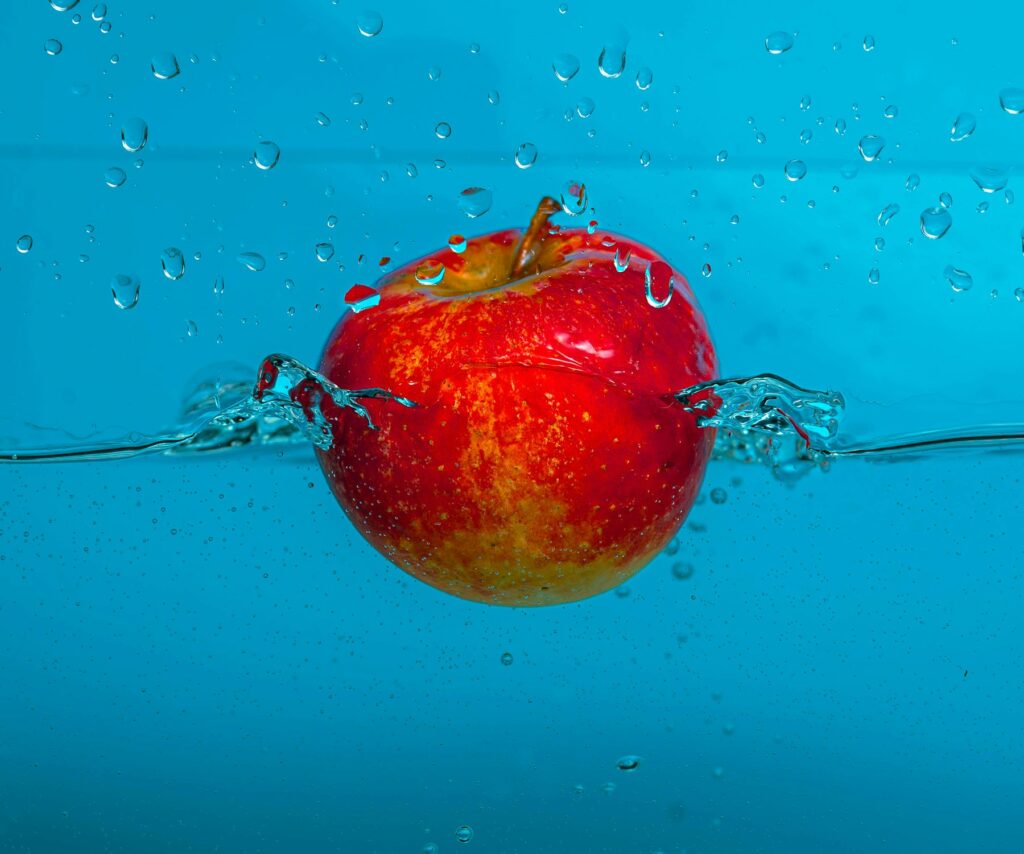
In this sink or float experiment, you guess first, then you test. A big apple floats. A small stone sinks. So size is not the answer. Let’s find out what is!
- Predict: I can guess if an object will sink or float, and say why.
- Classify: I can sort objects into two groups, “sink” and “float”.
- Explain: I can use the words buoyancy and dense.
- Test fairly: I can test one object at a time in the same water.
Tap each card to see what the word means.
- Always do this with a grown-up near the water. 👪
- Use big objects. Keep small things away from babies. 👶
- Wipe up spills so nobody slips. 🧻
- Do not eat food after it has been in the test water. 🚫
- Fill a big bowl with water. Put a towel under it.
- Pick 6 to 8 safe objects from your home.
- Hold up each object. Predict: will it sink or float? Say why.
- Put the objects in one at a time. Watch, then write the result.
🛟 Most of these float
⬇️ Most of these sink
🤔 Guess first: Which is heavier, a big apple or a small stone? Which one will float?
Your results can be different. Objects are not all the same. That is science!
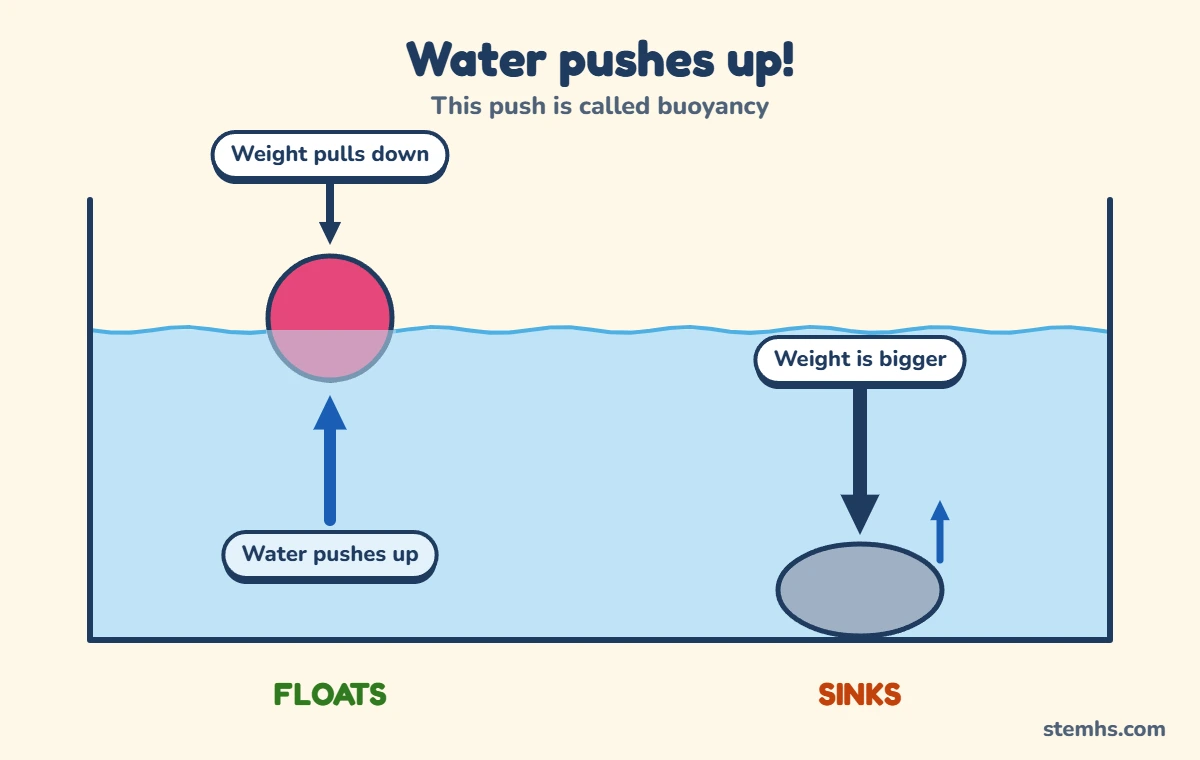
Gravity pulls every object down. The water pushes it up. This push is called buoyancy. If the push is strong enough, the object floats. If the object is too heavy for the push, it sinks.
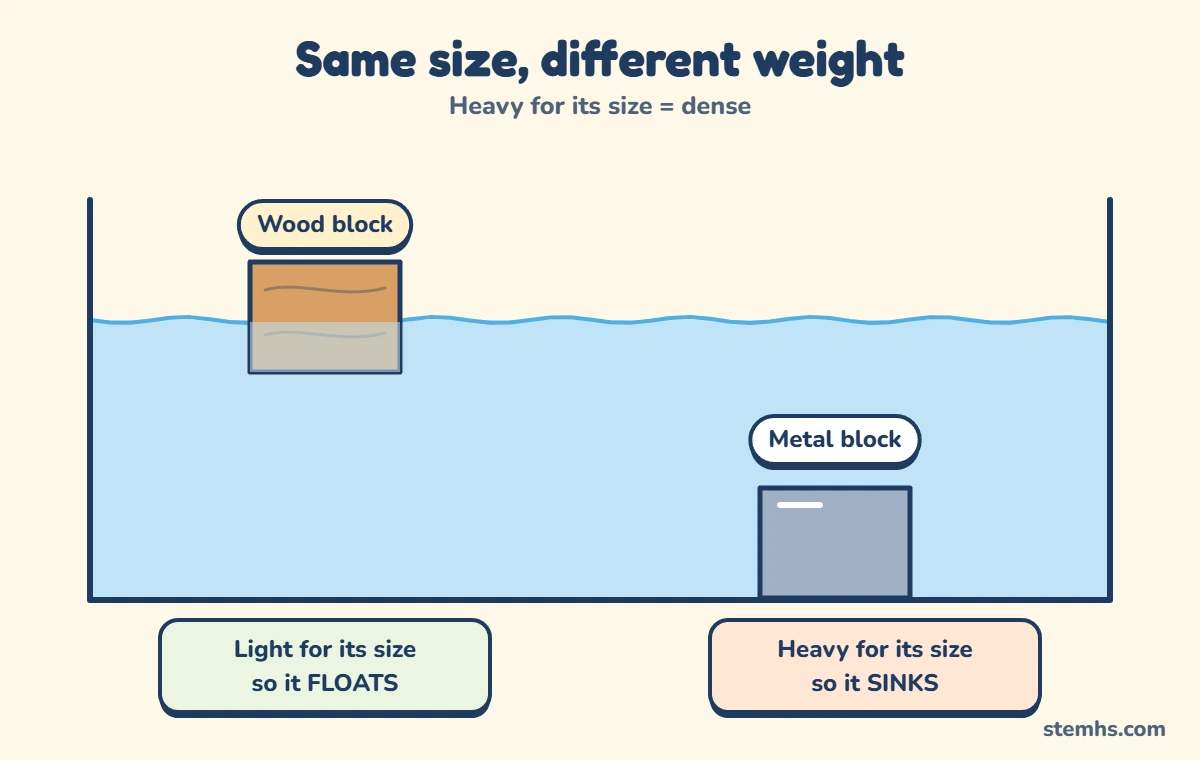
These two blocks are the same size. The metal block is much heavier. It is dense: heavy for its size. Scientists call this density. Things that are less dense than water float. Things that are more dense than water sink.
🍊 Orange test
Put an orange in the water. Then take off the peel and try again. The peel has tiny pockets of air. What happens without it?
🚤 Foil test
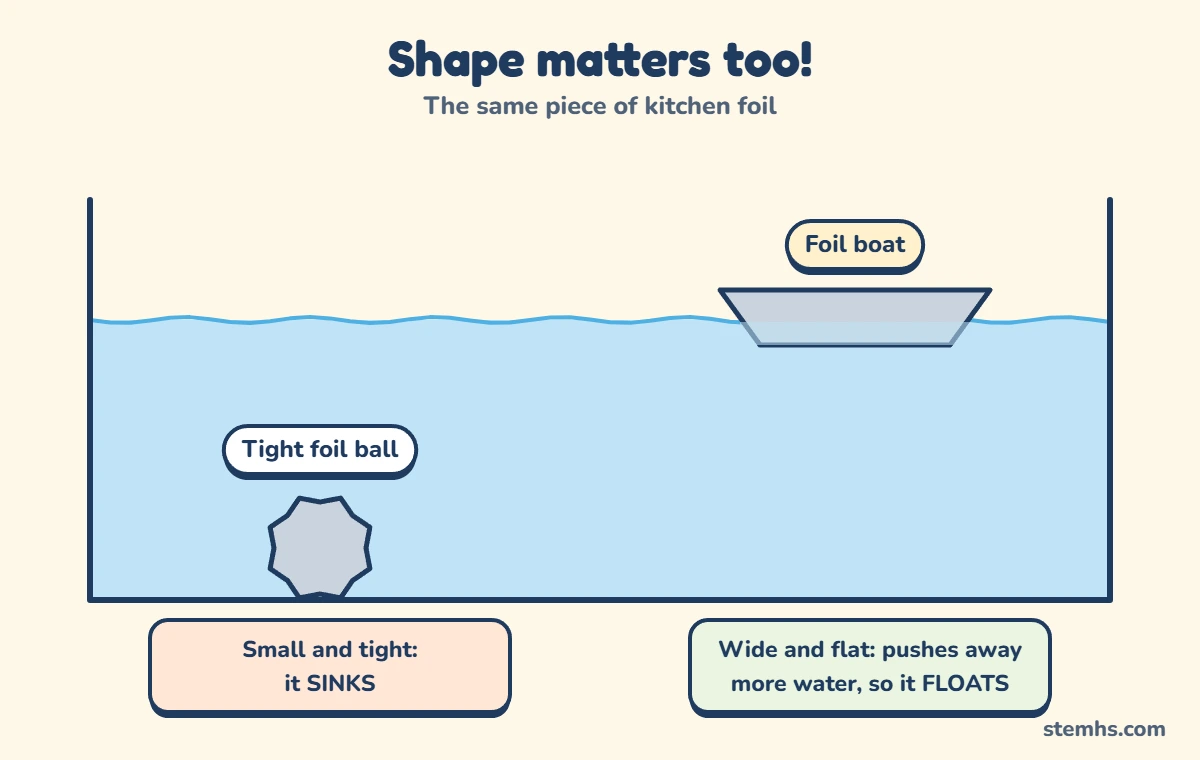
Squeeze some kitchen foil into a tight ball. Test it. Then make the same foil into a wide boat. Test it again.
Big ships are made of heavy metal, but they float. Their wide shape pushes away lots of water, so the water pushes up hard.
Objects to test, and what usually happens
Use this list to pick your objects. Predict first, then check. Your results can be different, and that is fine.
| Object | Usually | Why |
|---|---|---|
| An apple | Floats | Light for its size, with air inside |
| An orange with its peel | Floats | The peel is full of tiny air pockets |
| An orange without its peel | Sinks | No air pockets to hold it up |
| A potato | Sinks | Heavy for its size |
| A carrot | Sinks | Heavy for its size |
| A grape | Usually sinks | A little denser than water |
| A wooden spoon | Floats | Wood is less dense than water |
| A metal spoon | Sinks | Metal is much denser than water |
| A coin | Sinks | Small, but very heavy for its size |
| A cork | Floats | Cork is full of air |
| An ice cube | Floats | Ice is less dense than water |
| A plastic toy brick | Usually floats | Hollow, with air inside |
Predict, observe, explain
Do these three things for every object.
1. Predict
“I think the apple will float, because it feels light for its size.”
2. Observe
Put it in gently. Does it sink to the bottom, float on top or stay in the middle?
3. Explain
“The apple floated because it is less dense than water. The water pushed it up.”
Turn it into a science fair project
Sorting objects is a great start. For a science fair, you need a question with a number for an answer. Try this one:
How many coins can a foil boat hold before it sinks?
🔁 Change
The shape of the boat: flat, a tray with low sides, or a deep tub.
🔒 Keep the same
The same size piece of foil (20 cm by 20 cm), the same bowl of water and the same coins.
📏 Measure
Add coins one at a time. Count how many it holds. Test each shape 3 times.
Hypothesis: “If the boat has higher sides, then it will hold more coins, because it pushes away more water.”
Your display board
- Left panel: your question and hypothesis.
- Middle panel: photos of each boat and your steps.
- Right panel: your results table, a bar chart and your conclusion.
Plan it with the free Fair Test Planner. For a younger child, the sorting version on this page makes a simple first project.
Great job, scientist!
You predicted, tested and sorted. Now you know about buoyancy and density!
Let your child hold each object before they predict. Ask “Is it heavy for its size?” rather than “Is it heavy?”. That one question moves them from size to density. Accept every guess, then let the water give the answer.
Curriculum links: England Year 1 Everyday materials (compare and group materials by their properties) and Year 2 Uses of everyday materials. US NGSS 2-PS1-1 (describe and classify materials by their properties).
More help: STEM in Simple English for children learning English, and our free parent guide. Try next: the floating egg in 5 Kitchen Science Experiments shows density with salt water. Or make a baking soda and vinegar volcano to see a chemical reaction.
❓ Questions parents ask
Why do some things float and others sink?
It depends on density, which means how heavy something is for its size. Water pushes up on every object (buoyancy). Objects that are less dense than water are held up and float. Objects that are more dense than water sink.
What is buoyancy in simple words?
Buoyancy is the push of water that holds things up. When you put an object in water, it pushes some water out of the way, and the water pushes back up on it.
Why does a heavy ship float?
A ship is wide and hollow, with lots of air inside. Its shape pushes away a lot of water, so the water pushes up very hard. The ship is light for its size, even though the metal is heavy.
Does an orange sink or float?
An orange with its peel usually floats, because the peel has tiny pockets of air. Without the peel it usually sinks. It makes a great surprise test.
What age is the sink or float experiment for?
It suits ages 5 to 9. Younger children can predict and sort with help. Older children can explain their results with the words buoyancy and density, and try the foil boat challenge.
How do you make sink or float a science fair project?
Turn it into a question with a number for an answer, such as “How many coins can a foil boat hold before it sinks?”. Change only the boat shape, keep the foil size and water the same, and test each shape 3 times. Show the results in a table and a bar chart on a three-panel board.
What objects are good for a sink or float experiment?
Try an apple, an orange with and without its peel, a potato, a wooden spoon, a metal spoon, a coin, a cork and an ice cube. Choose large, safe objects for young children, and keep small items away from babies.
Did you finish?
Press the button to collect your First Experiment badge.