This KS2 day and night interactive model lets you spin the Earth yourself. You can see why your home has day, and then night, every 24 hours. Spin the 3D Earth, watch the Sun “rise” and “set”, and try the challenges. Then check what you learned with a quiz, flashcards and a matching game.
Spin the Earth and find out why we have day and night
- Explain: I can explain that day and night happen because the Earth spins on its axis.
- Time: I can say that one full spin (rotation) takes about 24 hours.
- The Sun: I can explain why the Sun seems to rise in the east and set in the west, even though it does not move.
- Compare: I can tell the difference between rotation (1 day) and orbit (1 year).
- Around the world: I can explain why it can be day in London and night in Sydney at the same time.
Curriculum link: KS2 Science, Year 5 “Earth and space”. Also great for Year 6 revision.
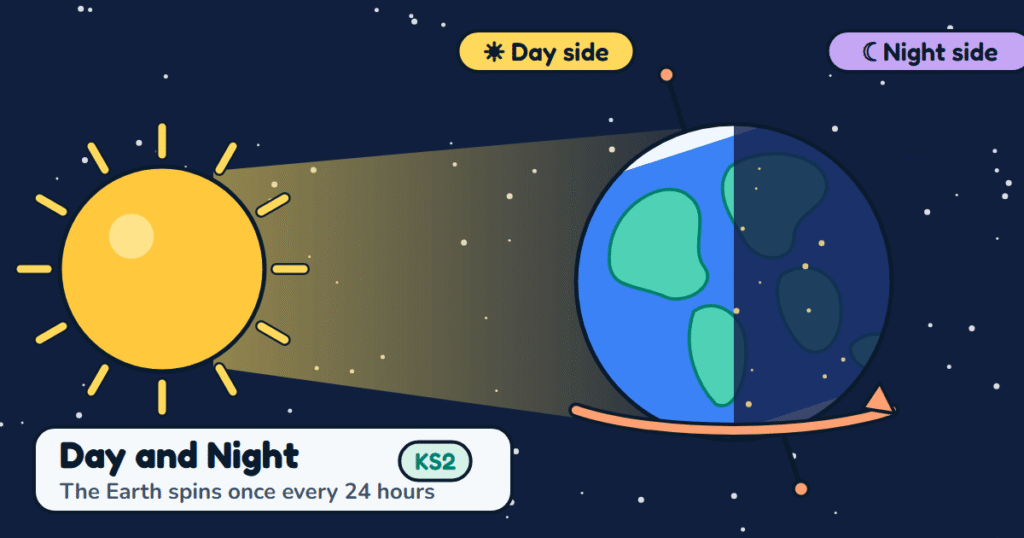
Day and night happen because the Earth spins. The Earth turns around an imaginary line called its axis. One full turn takes about 24 hours. The half of the Earth that faces the Sun has day. The half that faces away from the Sun has night.
The Sun does not move around the Earth. It only looks like it moves, because we are spinning.
Spin the Earth: KS2 day and night interactive model
Press Spin to make the Earth turn. The red pin shows a place on Earth. Watch the box at the top. It tells you if it is day, night, sunrise or sunset at your pin.
How to use the model
- Choose a place in My place (pin). You can also click the Earth to put the pin anywhere.
- Press Spin, or use + 1 hour to turn the Earth one hour at a time.
- Look at What the sky looks like from your pin. See the Sun rise in the east and set in the west.
- Look at the table. Find a place that has day while your pin has night.
- Try the 5 challenges under the model. Press Check after each one.
What causes day and night?
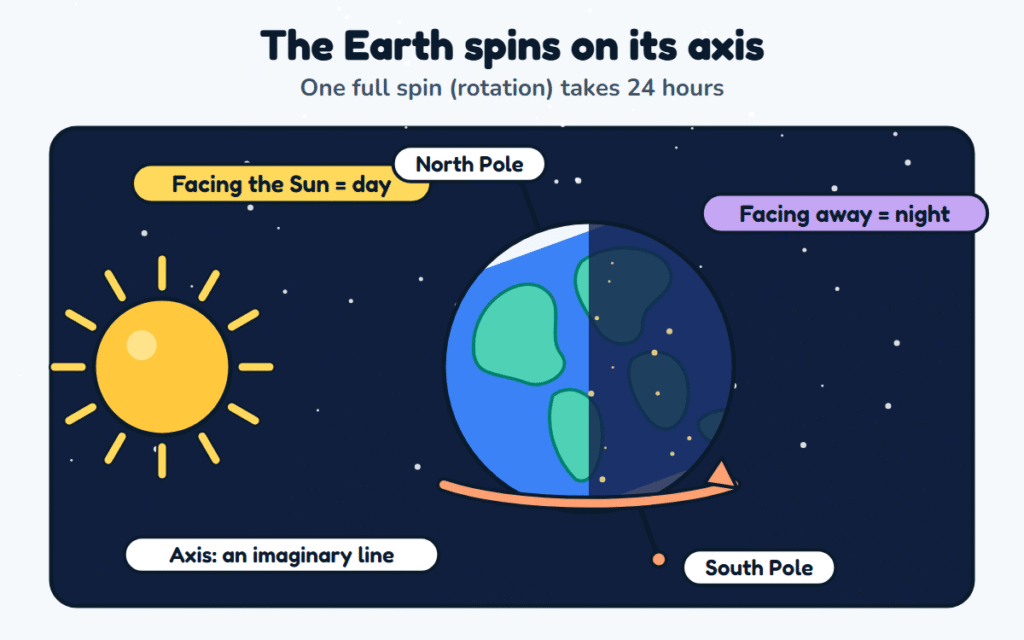
The Earth is always spinning, like a spinning top. Scientists call this spin rotation. The Earth spins around its axis. The axis is an imaginary line. It goes through the middle of the Earth, from the North Pole to the South Pole.
The Sun shines light on the Earth. But light can only reach one half of the Earth at a time.
- Day: your side of the Earth faces the Sun. The sky is bright.
- Night: your side of the Earth turns away from the Sun. It is in the Earth’s own shadow, so the sky is dark.
- 24 hours: one full spin takes about 24 hours. So every 24 hours you get one day and one night. Learn to write these hours on the 24-hour clock.
Does the Sun move across the sky?
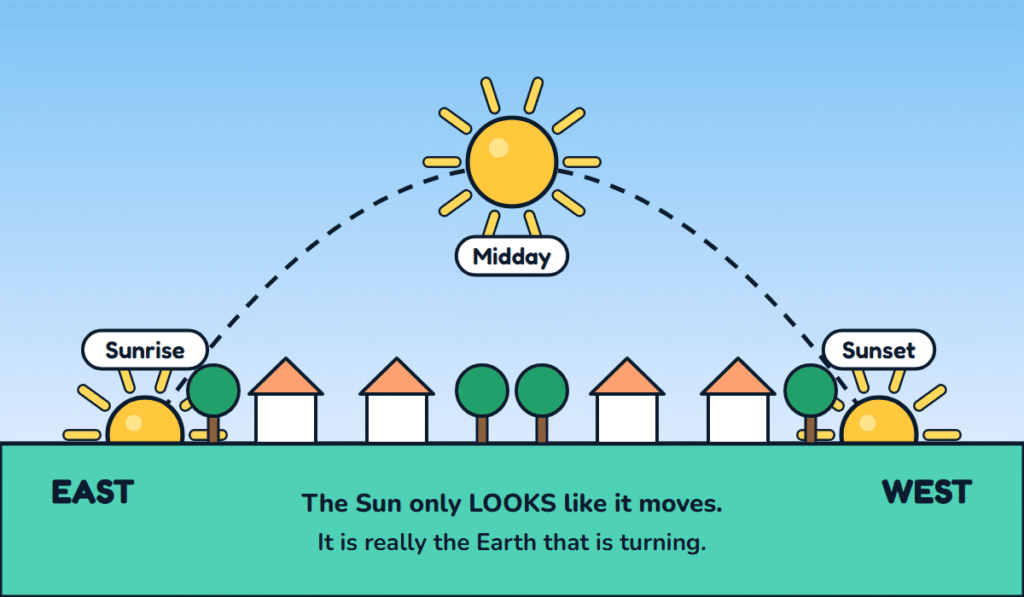
In the morning, the Sun seems to come up in the east. At midday it is highest in the sky. In the evening it seems to go down in the west.
But the Sun is not really moving across the sky. The Earth is turning. Think about a car window. When the car moves, the trees outside seem to move past you. The trees are still. You are the one moving. The Sun is the same. We call this the Sun’s apparent movement. “Apparent” means “how it looks”, not what really happens.
Three common mistakes about day and night
- “The Sun goes around the Earth.” No. The Earth spins, and it also travels around the Sun.
- “Night is when clouds cover the Sun.” No. Clouds can make the sky grey, but night comes when your side of the Earth faces away from the Sun.
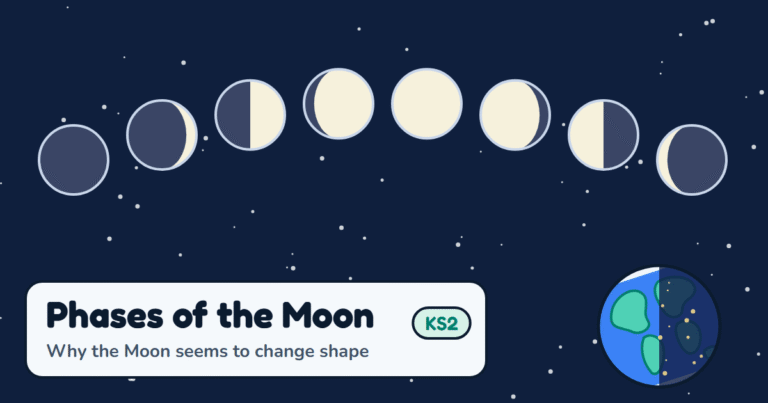
- “The Moon makes it dark.” No. The Moon does not cover the Sun at night. The Moon does not even make its own light. We see it because the Sun lights it up. Find out why the Moon seems to change shape.
Safety: never look straight at the Sun. It can hurt your eyes, even with sunglasses.
Rotation and orbit: what is the difference?
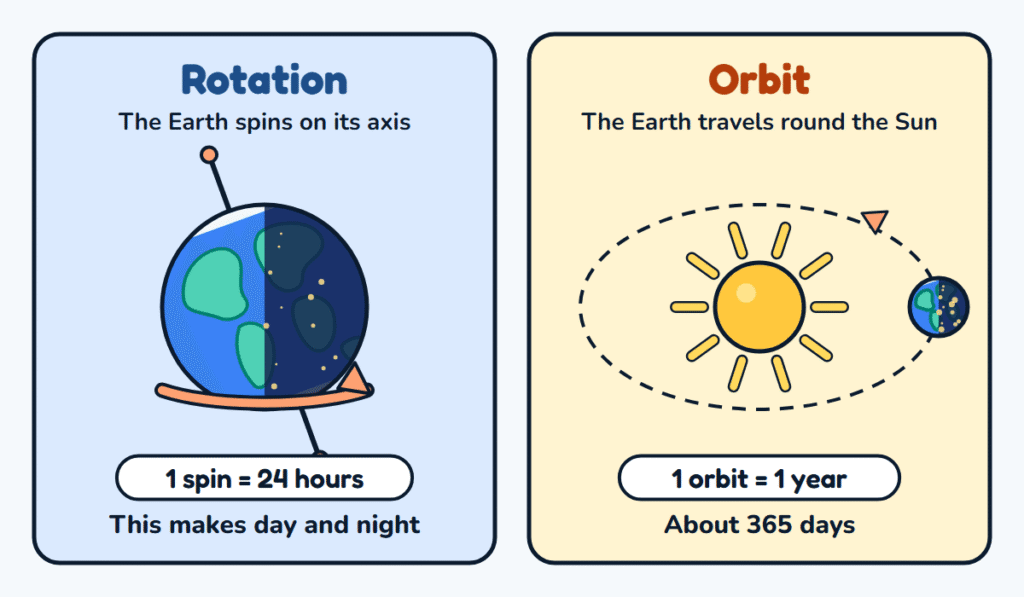
The Earth moves in two ways at the same time. It spins, and it travels around the Sun. These two words are easy to mix up:
| Word | What the Earth does | How long | What it gives us |
|---|---|---|---|
| Rotation | Spins on its axis | About 24 hours | Day and night |
| Orbit | Travels around the Sun | About 365 days | One year (and, with the tilt, the seasons) |
If the Earth stopped spinning but still went around the Sun, how long would one “day” be?
Talk about it, then open the answer.
Show the answer
One side would face the Sun for about half a year, and then the other side would. So one “day” would last about 6 months, and one “night” about 6 months too.
Day and night around the world
At any moment, half of the world has day and the other half has night. So people in different countries are at different times of the day.
- When it is midday in London, it is evening in Lahore, Pakistan.
- At the same time, it is the middle of the night in Sydney, Australia. Sydney is on the other side of the Earth.
- Countries in the east see the Sun first, because the Earth spins from west to east.
This is why the world has time zones. Each time zone sets its clocks so that midday is roughly when the Sun is highest. You can see this in the “Day and night around the world” table in the model.
Why are summer days longer than winter days?
The Earth’s axis is not straight up and down. It is tilted (it leans to one side). In June, the North Pole leans towards the Sun. The UK spends more of each spin in sunlight, so the days are long. In December, the North Pole leans away from the Sun, so the days are short.
- In London, a summer day has about 16 and a half hours of daylight. A winter day has under 8 hours.
- Near the North Pole, in places like Svalbard, the Sun does not set at all in summer. This is called the Midnight Sun. In winter the Sun does not rise for weeks. This is called the polar night.
Try it: in the model, choose June, put your pin on Svalbard and press Spin. Does it ever get dark?
Make your own day and night model at home
You need: a torch, a ball (or an orange), a stick or pencil, and a small sticker. Ask an adult to help push the stick through the ball.
- Push the stick through the middle of the ball. This is the Earth’s axis.
- Put the sticker on the ball. This is your home.
- Make the room dark. Put the torch on a table and switch it on. The torch is the Sun. It does not move.
- Hold the ball in the light. Turn it slowly, anticlockwise (from west to east).
- Watch the sticker. When is it in the light (day)? When is it in the dark (night)?
Key words for day and night
- Axis: an imaginary line through the Earth, from the North Pole to the South Pole. The Earth spins around it.
- Rotate / rotation: to spin around. One rotation of the Earth takes about 24 hours.
- Orbit: the path the Earth takes around the Sun. One orbit takes about 365 days.
- Daytime: when your side of the Earth faces the Sun and the sky is bright.
- Night-time: when your side of the Earth faces away from the Sun and the sky is dark.
- Sunrise: when the Sun first appears in the morning, in the east.
- Sunset: when the Sun goes out of sight in the evening, in the west.
- Apparent movement: how something looks like it moves, even though it is not really moving.
- Tilt: a lean to one side. The Earth’s axis is tilted.
- Time zone: an area of the world where people use the same clock time.
Flashcards: day and night words
Read the word. Say what it means. Then tap the card to check.
- axis
- An imaginary line through the Earth, from the North Pole to the South Pole.
- rotation
- One full spin of the Earth. It takes about 24 hours.
- orbit
- The path the Earth takes around the Sun. It takes about 365 days.
- daytime
- When your side of the Earth faces the Sun.
- night-time
- When your side of the Earth faces away from the Sun.
- sunrise
- When the Sun first appears in the morning, in the east.
- sunset
- When the Sun goes out of sight in the evening, in the west.
- apparent movement
- How the Sun looks like it moves across the sky, because the Earth is turning.
- tilt
- A lean to one side. The Earth’s axis is tilted, which gives us longer summer days.
- time zone
- An area of the world where people use the same clock time.
Day and night quiz: 10 questions
Pick an answer. You will see at once if it is right, and why. Every answer has an explanation, so read them all.
Day and night quiz
Question 1
What causes day and night on Earth?
Question 2
How long does the Earth take to spin around once?
Question 3
What is the Earth’s axis?
Question 4
Which part of the Earth has daytime?
Question 5
Where does the Sun seem to rise in the morning?
Question 6
The Sun seems to move across the sky during the day. Why?
Question 7
What is the difference between rotation and orbit?
Question 8
It is midday in London. What is it like in Sydney, Australia?
Question 9
Why are summer days in the UK longer than winter days?
Question 10
You make a model with a torch and a ball. What should the torch be?
Match the words to their meanings
Day and night: match the word to its meaning
Drag each meaning to the right word. Or tap a meaning, then tap a word. Press “Check my answers” when you finish.
Word
- axis
- rotation
- orbit
- daytime
- night-time
- sunrise
- sunset
Meaning (drag or tap)
- ✅ The Earth spins on its axis. This spin is called rotation.
- ✅ One rotation takes about 24 hours: one day and one night.
- ✅ The side facing the Sun has day. The side facing away has night.
- ✅ The Sun does not move. It only looks like it rises in the east and sets in the west.
- ✅ Rotation (1 day) is different from orbit (1 year).
- ✅ Different places have day and night at different times, so we have time zones.
Free printable: day and night worksheet
Two A4 pages: fill the gaps, true or false, match the words, draw the Sun’s path and a “think” question, plus a full answer page for parents and teachers. No email needed.
Download the free PDFCurriculum: in the National Curriculum for England, Year 5 pupils “use the idea of the Earth’s rotation to explain day and night and the apparent movement of the sun across the sky”. This page covers that objective and works well for Year 6 revision.
How to use it: start with the model on a big screen. Ask the class to predict before you press Spin. Then let pupils try the challenges in pairs. Finish with the quiz, the matching game and the worksheet.
For children learning English: pre-teach the words axis, rotate and orbit with the flashcards. Point to the model as you say each word. Short sentence starters help: “It is day because…”, “It is night because…”.
❓ Questions parents ask
What causes day and night? (simple answer for KS2)
The Earth spins on its axis once about every 24 hours. The half of the Earth facing the Sun has day. The half facing away from the Sun has night. As the Earth keeps spinning, each place moves from day into night and back again.
Does the Sun move around the Earth?
No. The Sun stays in the centre of the Solar System. The Earth spins, which makes the Sun look like it moves across the sky from east to west. The Earth also travels around the Sun once a year.
How long does it take the Earth to spin once?
About 24 hours. That is why one day and one night together last 24 hours.
Why is it day in the UK and night in Australia?
The UK and Australia are on almost opposite sides of the Earth. When the UK faces the Sun, Australia faces away from it, so it is night there.
How do you make a simple day and night model?
Push a stick through a ball to make the axis, put a sticker on it for your home, and shine a torch (the Sun) at it in a dark room. Turn the ball slowly from west to east and watch the sticker move from light (day) into shadow (night).
Which year group learns about day and night?
In England, day and night is part of the Year 5 “Earth and space” science unit in KS2. Many schools revise it in Year 6. Younger children can enjoy the model too.
Did you finish?
Press the button to collect your First Experiment badge.