The Moon looks different on different nights. Sometimes it is a thin slice. Sometimes it is a full, round circle. But the Moon does not really change shape. This page shows you why. You can move the Moon yourself in a 3D model, learn the phases of the Moon for KS2 in order, and check what you know with a quiz, flashcards and a matching game.
Learn the 8 phases of the Moon and why they happen
- Movement: I can describe how the Moon moves round the Earth.
- Light: I can explain that we see the Moon because it reflects light from the Sun.
- Phases: I can name the 8 phases of the Moon in order.
- Explain: I can use the Moon’s movement to explain why it seems to change shape.
- Shapes: I can say that the Sun, the Earth and the Moon are roughly spheres.
Curriculum link: KS2 Science, Year 5 “Earth and space”. See more Earth and space activities or check what each year group learns.
The Sun always lights half of the Moon. The Moon goes round the Earth. As it moves, we see a different amount of its lit half. These different shapes are called the phases of the Moon.
What are the phases of the Moon?
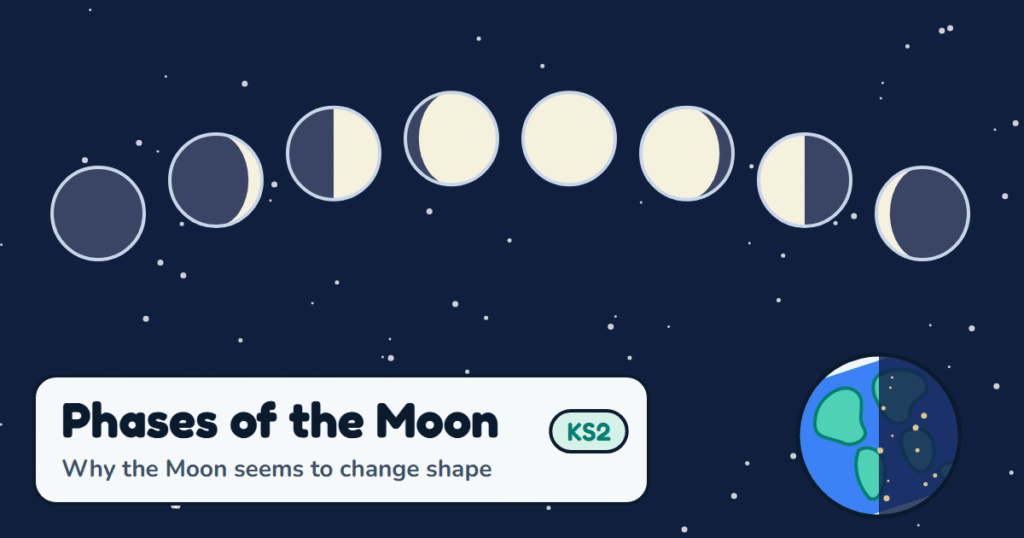
The phases of the Moon are the 8 shapes the Moon seems to have during one month: new Moon, waxing crescent, first quarter, waxing gibbous, full Moon, waning gibbous, last quarter and waning crescent. They happen because the Moon goes round the Earth, so we see different amounts of its sunlit half. These moon phases repeat about every 29.5 days.
A phase is the shape of the Moon that we see from Earth. The Moon goes through 8 main phases. Then it starts again. One full cycle takes about 29.5 days. This is called a lunar month. “Lunar” means “to do with the Moon”.
The Moon does not make its own light. It is a big ball of rock. We can see it because light from the Sun hits the Moon and bounces off it. Scientists say the Moon reflects sunlight.
Why does the Moon change shape?
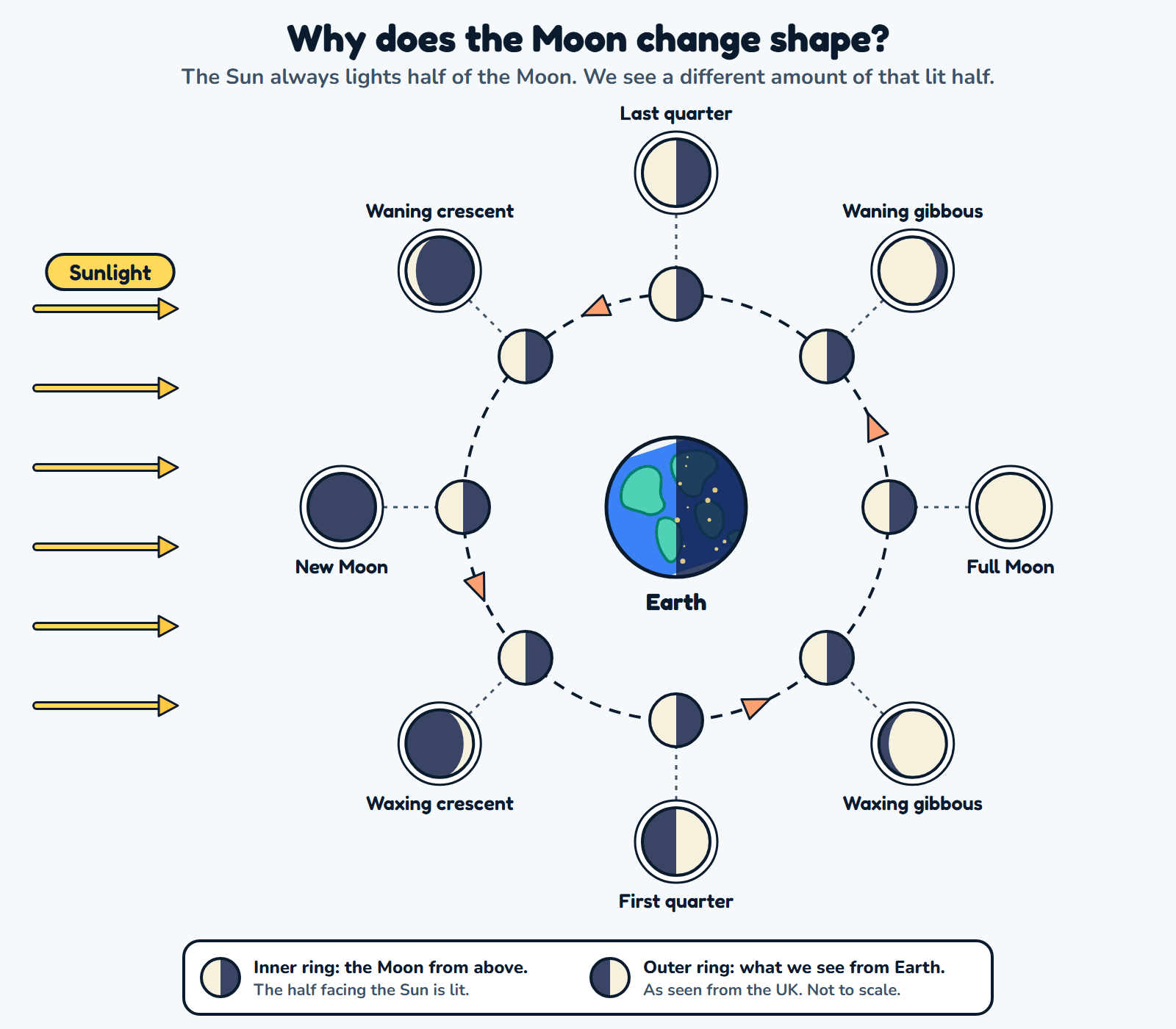
Look at the diagram. It shows three facts.
- The Sun lights half of the Moon. The half that faces the Sun is bright. The other half is dark. This is true all the time.
- The Moon goes round the Earth. Its path is called its orbit. One trip round takes about 27 days.
- We see a different amount of the lit half. When the lit half faces us, we see a full Moon. When the lit half faces away from us, we see almost nothing. In between, we see part of it.
Try it: move the Moon in 3D
Press Play to send the Moon round the Earth. Or use the slider to move it one day at a time. The box at the top shows what the Moon looks like from Earth. Then try the 6 challenges.
How to use the model
- Press From above to look down on the Earth and the Moon.
- Press Phase ▶ to jump to the next phase. Watch the shape in the box change.
- Look at the orange dot on the Moon. It always points at the Earth.
- Press Show tonight’s Moon to see today’s phase. Then look outside and check.
The 8 phases of the Moon in order
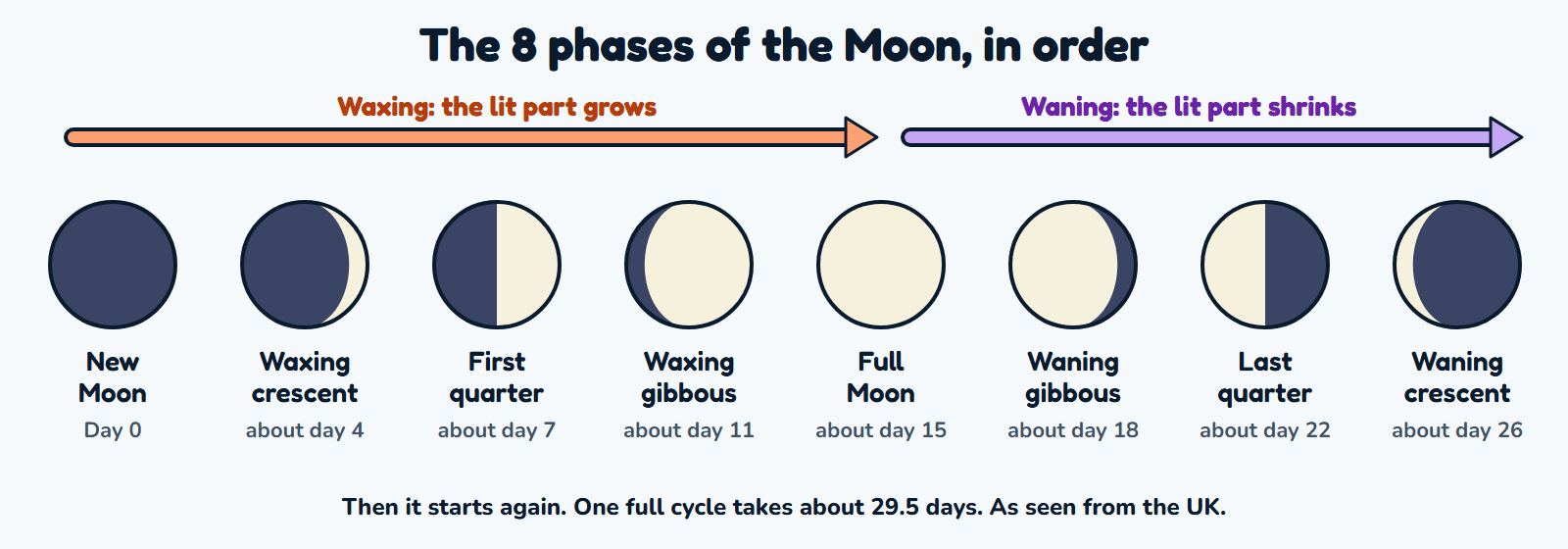
| Phase | What you see | About which day |
|---|---|---|
| New Moon | Almost nothing. The lit half faces away from us. | Day 0 |
| Waxing crescent | A thin slice, lit on the right | About day 4 |
| First quarter | The right half is lit | About day 7 |
| Waxing gibbous | More than half lit, still growing | About day 11 |
| Full Moon | A full, round circle | About day 15 |
| Waning gibbous | More than half lit, now shrinking | About day 18 |
| Last quarter | The left half is lit | About day 22 |
| Waning crescent | A thin slice, lit on the left | About day 26 |
Some new words help you name the phases:
- Crescent: a thin, curved shape, like a slice.
- Gibbous: more than half lit, but not full.
- Quarter: we see half of the Moon’s face lit. It is called a quarter because the Moon has gone a quarter (or three quarters) of the way round the Earth.
Is the Moon waxing or waning?
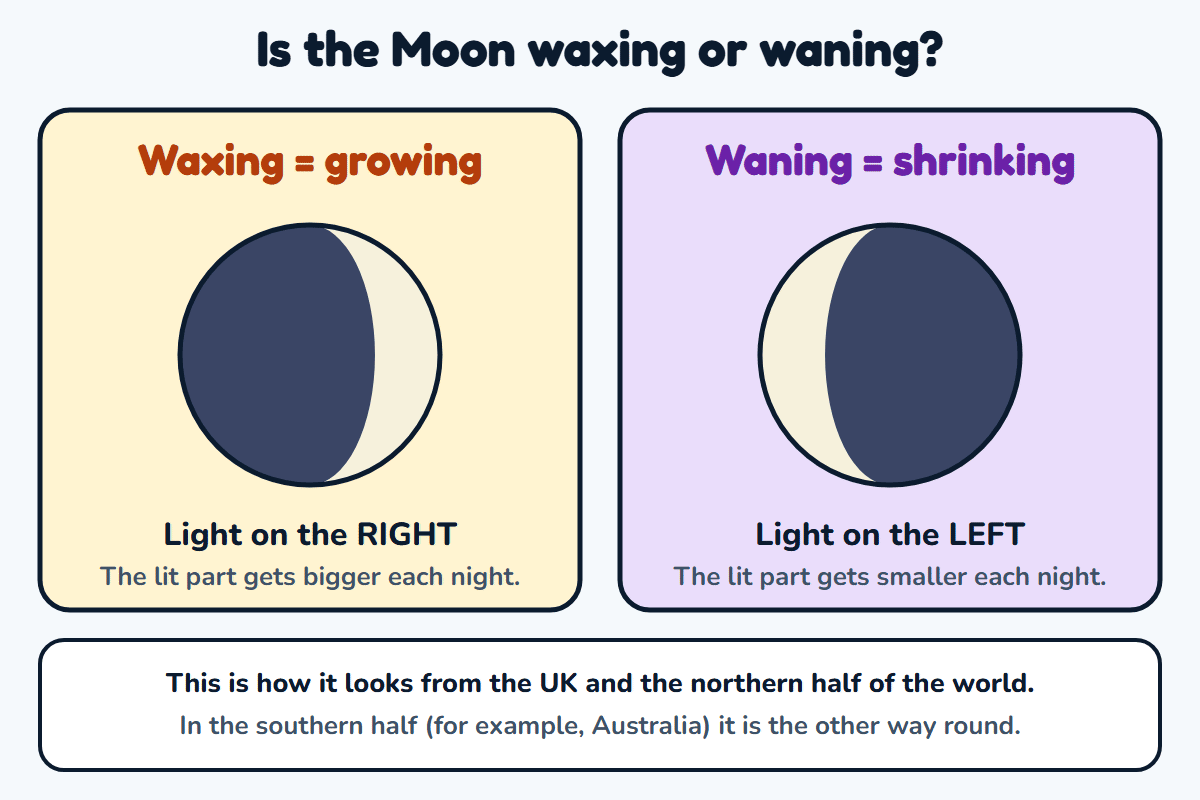
Waxing means growing. From the new Moon to the full Moon, we see a little more of the lit half each night. Waning means shrinking. From the full Moon back to the new Moon, we see a little less each night.
Here is a simple rule for the UK. If the light is on the right, the Moon is waxing. If the light is on the left, the Moon is waning. In the southern half of the world, for example in Australia, it is the other way round.
How does the Moon move?
The Moon is the Earth’s satellite. A satellite is an object that goes round a planet. The Moon goes round the Earth once in about 27 days.
But the phases take about 29.5 days, not 27. Why? While the Moon goes round the Earth, the Earth is also moving round the Sun (see how the Earth spins and orbits the Sun). So the Moon needs about two more days to get back to the same place in line with the Sun.
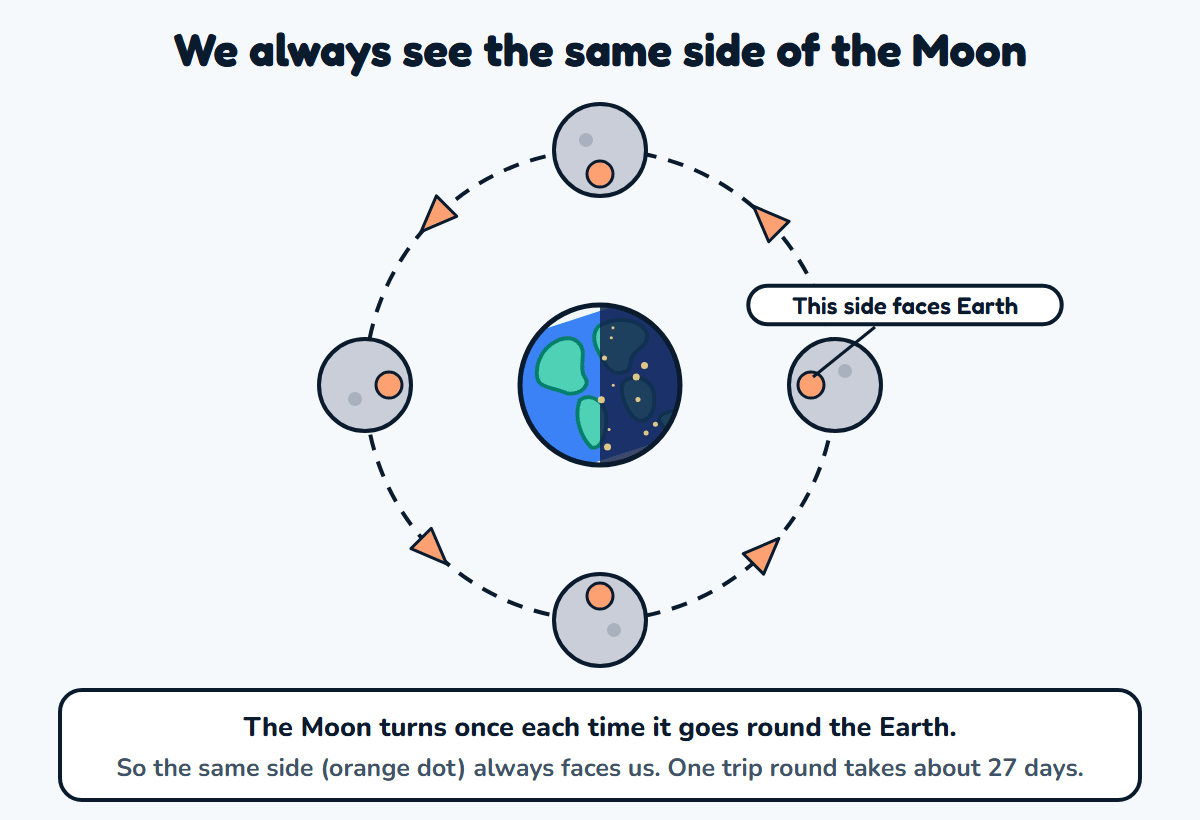
The Moon also spins. It turns once each time it goes round the Earth. So the same side of the Moon always faces us. We never see the other side from Earth.
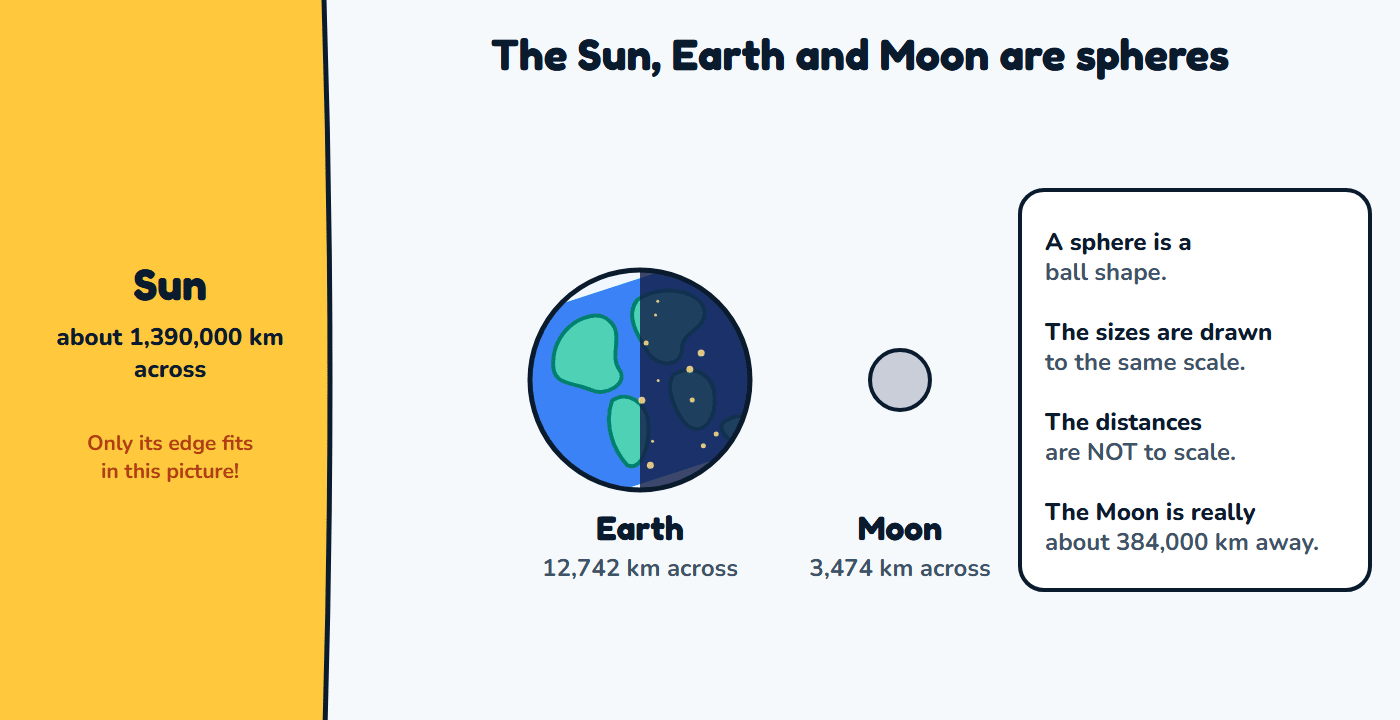
The Sun, the Earth and the Moon are all roughly spheres. A sphere is a ball shape. The Moon looks flat in the sky, like a coin. That is only because it is very far away, about 384,000 km.
Watch the Moon go round the Earth
Four common mistakes about the Moon
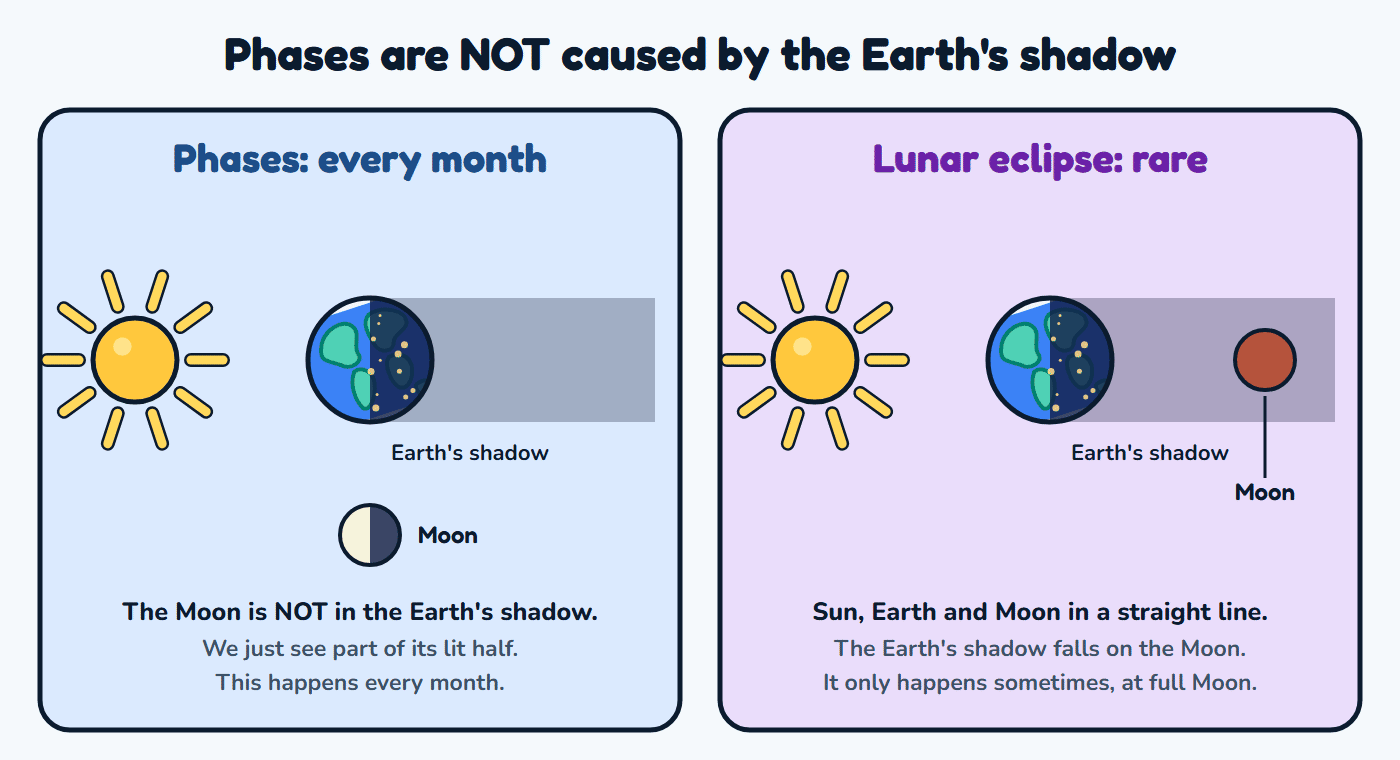
- “The Earth’s shadow makes the phases.” No. In each phase, the Moon is not in the Earth’s shadow. We just see part of its lit half. The Earth’s shadow only falls on the Moon in a lunar eclipse, and that is rare.
- “Clouds cover part of the Moon.” No. Clouds can hide the Moon, but the phases happen on clear nights too.
- “The Moon makes its own light.” No. The Moon reflects light from the Sun.
- “The Moon only comes out at night.” No. You can often see the Moon in the daytime too. Look for it in the morning or afternoon near a quarter Moon.
Make a Moon model at home
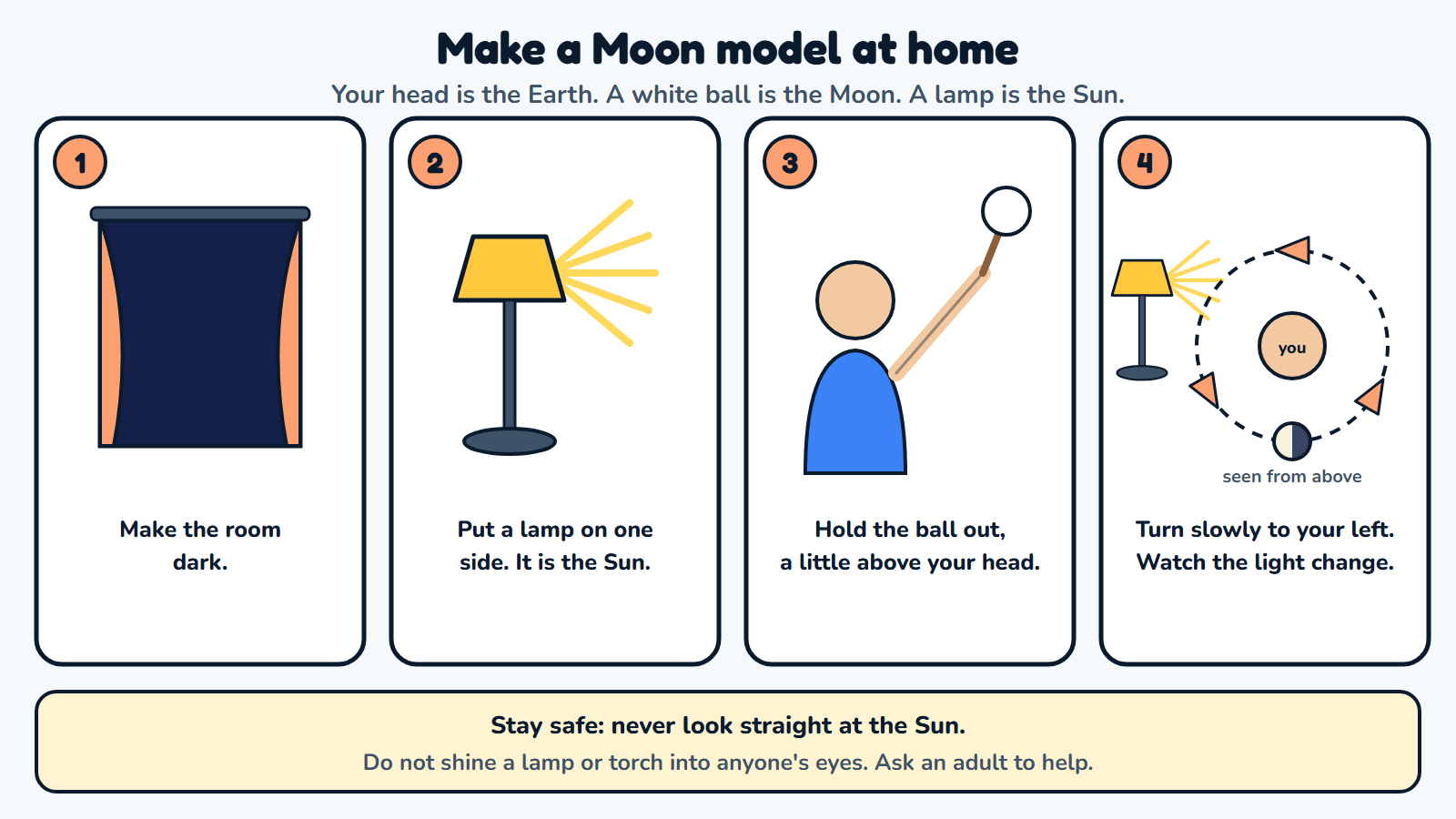
You need: a lamp with no shade, a white ball (or an orange) on a pencil, and a dark room. Your head is the Earth. The ball is the Moon. The lamp is the Sun.
- Make the room dark. Switch on the lamp on one side of the room.
- Stand facing the lamp. Hold the ball out in front of you, a little above your head. This is the new Moon.
- Turn slowly to your left. Keep looking at the ball.
- Watch the lit part of the ball grow and then shrink. Can you find all 8 phases?
Safety: never look straight at the Sun. Do not shine a lamp or torch into anyone’s eyes.
Keep a Moon diary
Scientists learn by watching carefully over time. Look at the Moon every day for a month. Draw what you see, and write the date and time. After a month, look for patterns. How many days are there from one full Moon to the next? Which side grows first?
Our free Moon diary has a box for each day and pattern questions at the end. Use Show tonight’s Moon in the model to check your drawings.
At a full Moon, where is the Moon: between the Earth and the Sun, or on the far side of the Earth?
Show the answer
On the far side of the Earth from the Sun. Then the whole lit half of the Moon faces us, so we see a full circle.
Phases of the Moon quiz: 10 questions
Pick an answer. You will see at once if it is right, and why. Read every explanation.
Phases of the Moon quiz
Question 1
Why can we see the Moon in the sky?
Question 2
How much of the Moon does the Sun light up?
Question 3
Why does the Moon seem to change shape?
Question 4
About how long does it take to go from one new Moon to the next new Moon?
Question 5
At a new Moon, where is the Moon?
Question 6
At a full Moon, what do we see?
Question 7
What does “waxing” mean?
Question 8
From the UK, you see a Moon that is lit on the right side. What is it doing?
Question 9
Why do we always see the same side of the Moon?
Question 10
Which sentence about the Sun, the Earth and the Moon is true?
Key words for the phases of the Moon
Flashcards: Moon words
Read the word. Say what it means. Then tap the card to check.
- Moon
- A big ball of rock that goes round the Earth.
- orbit
- The path an object takes as it goes round another object.
- phase
- The shape of the Moon that we see from Earth.
- reflect
- To bounce light back. The Moon reflects light from the Sun.
- waxing
- Growing. Each night we see more of the lit part.
- waning
- Shrinking. Each night we see less of the lit part.
- crescent
- A thin, curved shape, like a slice.
- gibbous
- More than half lit, but not full.
- quarter
- Half of the face we see is lit. The Moon is a quarter of the way round.
- lunar month
- About 29.5 days, from one new Moon to the next.
- satellite
- An object that goes round a planet. The Moon is the Earth’s satellite.
- sphere
- A ball shape. The Sun, the Earth and the Moon are spheres.
Match the words to their meanings
Phases of the Moon: match the word to its meaning
Drag each meaning to the right word. Or tap a meaning, then tap a word. Press “Check my answers” when you finish.
Word
- phase
- orbit
- reflect
- waxing
- waning
- crescent
- gibbous
- lunar month
Meaning (drag or tap)
- ✅ The Moon does not make light. It reflects light from the Sun.
- ✅ The Sun always lights half of the Moon.
- ✅ The Moon goes round the Earth, so we see different amounts of its lit half.
- ✅ There are 8 phases. One cycle takes about 29.5 days.
- ✅ Waxing means growing. Waning means shrinking.
- ✅ The Sun, the Earth and the Moon are roughly spheres.
Free phases of the Moon printables
All five are free PDF downloads for home and class. No email needed. Find more in our free printables library.
Phases of the Moon worksheet
Name the phases on a diagram, waxing or waning, true or false, cut-and-order cards and “explain” questions, plus a full answer page. No email needed.
Download the free PDFMy Moon diary
30 boxes to draw the Moon each day, pattern questions and a teacher note.
Download the free PDFMoon phases poster
A classroom wall chart of the 8 phases round the Earth, with waxing and waning.
Download A4 Download A3Moon phase wheel
Cut out two wheels, join them with a paper fastener and turn to see each phase in order.
Download the free PDFMoon word mat and flashcards
12 key words with simple meanings, and fold-over flashcards.
Download the free PDFCurriculum: in the National Curriculum for England, Year 5 pupils should “describe the movement of the Moon relative to the Earth” and describe the Sun, Earth and Moon as approximately spherical bodies. The phases are the result of that movement, so this page teaches them through it.
How to use it: start with the torch-and-ball model so pupils feel the movement. Then use the 3D model on a big screen and ask pupils to predict each phase before you press Phase ▶. Finish with the quiz and the worksheet. The Moon diary works well as a month-long homework task.
For children learning English: pre-teach orbit, reflect, waxing and waning with the flashcards (more tips in STEM for children learning English). Useful sentence starters: “We see a full Moon because…”, “The Moon is waxing because…”.
Related: Day and night: spin the Earth (also Year 5 Earth and space). New to teaching science at home? Read the guide for parents.
❓ Phases of the Moon: questions people ask
How many phases of the Moon are there?
There are 8 main phases: new Moon, waxing crescent, first quarter, waxing gibbous, full Moon, waning gibbous, last quarter and waning crescent. Then the cycle starts again.
Why does the Moon change shape? (simple answer for KS2)
The Moon does not really change shape. The Sun always lights half of it. As the Moon goes round the Earth, we see a different amount of that lit half.
Does the Earth’s shadow cause the phases of the Moon?
No. In each phase, the Moon is not in the Earth’s shadow. The Earth’s shadow only falls on the Moon during a lunar eclipse, which only happens sometimes, at full Moon.
How long is the lunar cycle?
About 29.5 days, from one new Moon to the next. The Moon goes round the Earth in about 27 days, but it needs about two more days to line up with the Sun again, because the Earth is moving round the Sun too.
Why can you see the Moon in the daytime?
The Moon is often above the horizon during the day. It reflects sunlight, so it is bright enough to see in a blue sky, especially near the first quarter and the last quarter.
Which year group learns about the phases of the Moon?
In England, the movement of the Moon is part of the Year 5 “Earth and space” science unit in KS2. Many schools revise it in Year 6.
Did you finish?
Press the button to collect your First Experiment badge.