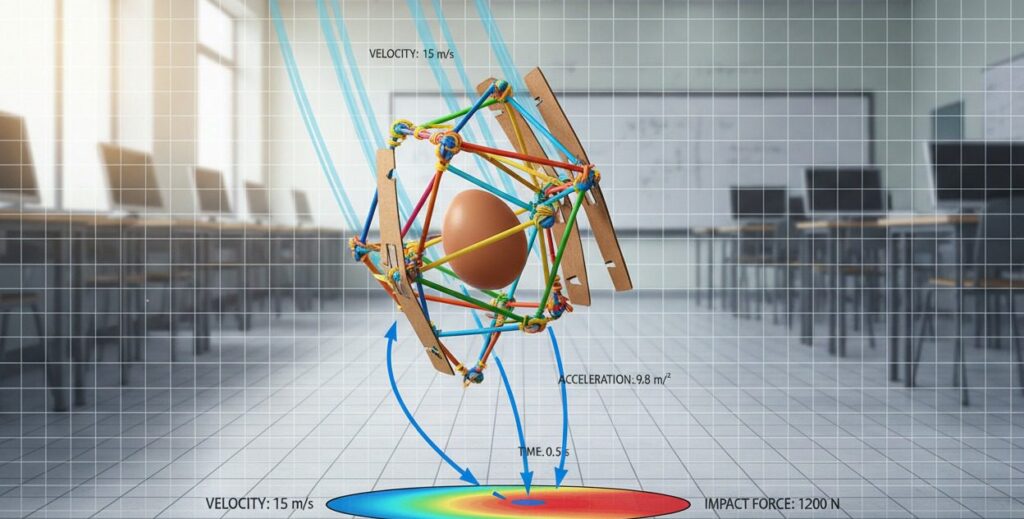
Want to test your egg drop design without wasting real eggs? Use our free virtual Egg Drop Simulator to test gravity, impact force, and cushioning materials.
Splat! The none (hard floor) stopped the egg too quickly (in just 1 cm). The impact force was 245N! Try a thicker cushion or parachute.
Your Lab Experiment Log
2 Trials| # | Drop Height | Egg Size | Cushion Material | Impact Speed | Impact Force | Outcome |
|---|---|---|---|---|---|---|
| #2 | 5.0 m | Small | 🧱 None (Hard Floor) | 9.9 m/s | 245 N (/ 55N) | 💥 SPLAT |
| #1 | 3.5 m | Small | 📦 Cardboard Box | 8.3 m/s | 34 N (/ 55N) | ✅ SAFE |
How I Use This Tool in My Classroom
Before we even touch a cardboard box or a roll of bubble wrap, I have my students open this egg drop simulator on their tablets. It’s a fantastic way to introduce the engineering design process. I ask them to slide the height to 5 meters and choose a hard floor. We watch the egg splat. Then, I have them switch to a sponge or bubble wrap and drop it again.
It’s amazing to see their faces when the egg survives. Once they’ve found a material that works, I tell them to log their data in our Fair Test Planner. This ensures they are only changing one variable at a time—a crucial skill for any young scientist preparing for a science fair.
The Science Behind the Egg Drop Simulator
When you hit the drop button, the egg drop simulator is doing real math in the background. As the egg falls, gravity accelerates it toward the ground. Its potential energy quickly turns into kinetic energy. The moment it hits the surface, it has to stop moving.
This sudden stop creates an impact force. If that force is higher than the shell's structural limit, the egg breaks. The formula for this is Force = (Mass × Velocity²) ÷ (2 × Stopping Distance). I usually don't show this exact math to my younger students, but I do explain that because velocity is squared, dropping an egg from twice as high creates four times the impact force.
Why Stopping Distance Saves the Egg
The secret to winning an egg drop challenge is increasing the "stopping distance." If an egg hits a concrete floor, it stops in about 1 centimeter. The force is massive. But if you use our egg drop simulator to test bubble wrap, the egg gets to slow down over 10 or 20 centimeters. This longer stopping time absorbs the energy and drops the force to a safe level.
I also love using the parachute setting. It works on a different principle entirely. Instead of cushioning the blow, it creates air drag. Just like the engineers at NASA design heat shields to slow down spacecraft, a parachute lowers the egg's maximum falling speed before it even reaches the ground.
4 Real-Life Classroom Test Ideas
Once your students have mastered the egg drop simulator and understand the physics, it’s time to get messy. When I move to the physical build, I always keep the materials budget low. Here are my favorite, teacher-approved ideas that you can build with household items:
The Straw Fortress: Have students tape drinking straws together to form a protective geometric cage around the egg. The straws act as a crumple zone, absorbing the shock on impact just like the bumper of a car.
The Cereal Cushion: Grab some plastic zip-top bags and a box of puffed rice cereal. If students place the egg inside and fill the empty space with cereal, it acts as a highly effective shock absorber. Popcorn or oatmeal works just as well.
The Balloon Bungee: Stretch a few balloons over the egg and tape them tightly. This creates a tensegrity structure. The rubber acts like a bouncy suspension system and prevents the shell from ever touching the ground.
The Paper Parachute: Challenge students to make a parachute using a plastic grocery bag and some string. This mimics the parachute setting in the simulator and teaches them about air resistance. If they enjoy this, I highly recommend trying our Paper Bridge Challenge next to explore structural engineering.
Test Your Knowledge
Before we wrap up, I always like to check for understanding. I’ve designed this egg drop simulator to be a launchpad for deeper discussions. If you want to see how well your students grasped the concepts of impact force, gravity, and kinetic energy, have them take our interactive STEM Test for Kids.
Frequently Asked Questions
What is an egg drop simulator?
An egg drop simulator is an interactive physics tool that models the classic science experiment. It allows you to test different drop heights, egg weights, and cushioning materials virtually to see the impact force and whether the egg survives, without wasting real eggs.
What is the best material for an egg drop challenge?
The best materials are those that increase the "stopping distance" meaning they let the egg slow down over a longer distance rather than stopping instantly. Bubble wrap, sponges, and cardboard boxes are excellent because they absorb the kinetic energy and reduce the impact force on the shell.
Why does the egg break when dropped?
When an egg falls, gravity accelerates it, converting potential energy into kinetic energy (speed). If it hits a hard surface like concrete, it stops instantly. This sudden stop creates a massive impact force. If that force is greater than the eggshell's structural limit, the shell fractures.
How does a parachute help protect a dropped egg?
A parachute creates air resistance (drag) as the egg falls. This limits the maximum speed (terminal velocity) the egg can reach. Because the egg is moving much slower when it hits the ground, the impact force is significantly lower, making it much more likely to survive.
What is the science behind the egg drop challenge?
The egg drop challenge is a demonstration of Impulse and Momentum (F×t=Δp). To save the egg, you must increase the time it takes for the egg to stop. Cushioning materials do exactly this by compressing upon impact, which stretches out the collision time and lowers the peak force.
Can I use this virtual simulator for a school science project?
Yes! This simulator is a perfect way to test your hypothesis before building a physical model. You can use the "Lab Experiment Log" table at the bottom of the tool to record your virtual data, compare the forces, and include it in your science fair write-up.
What is the highest safe drop height for an egg?
There is no single "safe" height because it depends entirely on the egg's mass and the cushioning. An egg dropped from 10 meters onto a hard floor will break. However, an egg dropped from 10 meters with a parachute and a thick sponge landing pad can easily survive. Use the simulator to test your exact setup!
Why does a heavier egg break more easily than a lighter egg?
Impact force is directly proportional to mass (F=ma). A jumbo egg weighs more than a small egg, meaning it carries more momentum as it falls. When it hits the ground, it requires more stopping force, which increases the likelihood of the shell cracking compared to a lighter egg.
Did you finish?
Press the button to collect your First Experiment badge.